The Circular City Centre (C3) is a competence and resource hub within the European Investment Bank, funded by the European Commission as part of the Circular Cities and Regions Initiative (CCRI). It supports EU cities in their transition to a circular economy by offering tailored advisory programmes.
This Q&A sessionwill answer your questions about C3's advisory programmes.
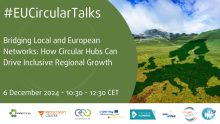
The ECESP Leadership Group Towards a European Network of Circular Economy Hubs organised the #EUCircularTalks event on Bridging Local and European Networks: How Circular Hubs Can Drive Inclusive Regional Growth.
This event explored the role of EU networks in advancing circular economy goals across Europe, focusing on how local circular hubs can leverage their strengths to foster inclusive regional growth.
Up2Circ (Boosting the uptake of circular business model, product and process innovation) is an international project funded by the Horizon Europe programme which aims to accelerate and scale up the transition of European SMEs towards a circular economy.
Resources without identity become waste, and this issue must be tackled in order to foster the circular economy. This webinar will discuss methods for assigning appropriate information to goods, tracking them and then processing and transfering this data efficiently, using state-of-the-art technologies such as AI, visual tracking systems, the Internet of Things and common communication languages.
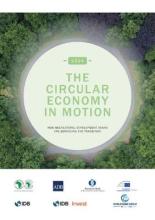
Multilateral development banks have a key role to play in supporting and financing circular approaches. Recognising this, a group of these banks came together to discuss how to better support the circular economy and promote an exchange of knowledge with the private sector, civil society, and local, regional and national authorities.
This report is a result of their work. It presents 20 case studies from around the world that highlight the kinds of support on offer, such as advisory activities, public-sector lending, private-sector investments and backing for the financial sector. Sharing these experiences is important for identifying and adopting successful approaches that can be replicated and scaled up around the world.
Are you driving innovation in sustainable energy and contributing to a circular economy for Europe? Does your organisation have a pioneering project that demonstrates the potential of the circular economy for reducing energy consumption, promoting renewable energy or minimising waste?
Then submit your project to the EU Sustainable Energy Week (EUSEW) Awards 2025!
Revivack has set up the world's first system based on blockchain technology that facilitates the individual return of unwanted items to the manufacturer. These items can therefore be recovered in an orderly, transparent and reliable way, contributing to the promotion of the circular economy.
This webinar will delve into recommendations for unlocking funding for circular economy projects. It will analyse the regulatory, market, social and technological barriers hindering the scaling and replication of circular economy models, and discuss strategies to overcome these challenges. By sharing lessons learned from successful EU initiatives, participants will gain insight that will enable them to replicate these initiatives in their own regions and cities.
The EcoSynergy System proposes a platform of common interest that brings together experts, companies, ecologists and developers to implement a new circular economy model.
In this model, platform members hand in any type of clean raw materials from packaging owned by individuals, service activities and industry to the EcoSynergy system. These materials are suitable for direct use in industries with a minimal environmental impact, and are monetised in the ECOSS environmental blockchain algorithm.
The ECOSS environmental blockchain algorithm rewards members through economic incentives by enabling them to access food and non-food products directly at production/factory prices.
This second webinar in the Circular Economy Knowledge Hubs Webinar Series will showcase regional and global perspectives on implementing circular economy activities, with a focus on how knowledge platforms can drive awareness, build capacity and inspire action among policy makers, producers and consumers.
The built environment accounts for at least 40% of anthropogenic greenhouse gas emissions. For the Alps, it is key to use local resources effectively while upholding EU rules and promoting the adoption of common standards across the building value chain.
The European Interreg Alpine Space project BAUHALPS is endeavouring to meet these challenges by developing and testing a model that combines New European Bauhaus concepts with sustainability measurements and indicators in an innovative way.