Applications are open for hosting EU Green Week 2025 partner events! Interested in hosting an event to raise awareness about the circular economy? Read the guidelines and apply now!
The Festival of Circular Economy is an opportunity to make connections, translate theory into positive, practical action, celebrate successes, learn from mistakes and help others avoid them, and make a difference by thinking and doing things differently.
The EU Green Electronics Working Group brings together representatives from Horizon Europe projects dedicated to promoting greener and more sustainable electronics across Europe. The goal is to enhance visibility and coordination between them and advance green electronics by developing innovative materials, next-generation manufacturing processes and improved recycling techniques.
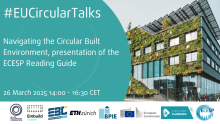
This Circular Talk focused on research into the circular built environment.
Researchers and policymakers talked about their publications, and a comprehensive reading guide was presented which summarises these and other key publications to help participants navigate the wealth of information available on the circular built environment.
The circular economy can help us address many of the crucial challenges and problems that we and our planet face today, such as wastage in different forms, resource depletion and climate change. Cities have a very important role in the circular transition as cradles or ecosystems and catalysts for circular change.
This guidance document outlines why cities should actively engage in and support others in the circular transition and how they can do that through 15 circular steps. The steps are divided into three phases: prepare and plan, facilitate and act, and invest and implement.
The BIOTRANSFORM project (Circular BIOeconomy TRANSFORMation for regions by enabling resource and governance networks) is hosting its final event. Come and find out about the project’s key achievements, practical outcomes and future potential to support Europe’s transition to a circular bioeconomy!
The circular economy is reshaping how we use natural resources, but how far have we come? Are products in Europe truly lasting longer? Is the European economy becoming more circular?
This European Environment Agency webinar will explore these questions and more, drawing insights from the EEA’s latest briefings.
This conference will present papers by young scientists, PhD students, students and scientific groups on new technological and IT solutions and innovative products and materials supporting sustainable (including circular) and competitive development.
Representatives of science, industry and start-ups will also promote implemented projects, innovative product solutions and innovations in the business process.
EUIndTech2025 will bring together stakeholders from research organisations, industry, industry associations, NGOs and policy makers to discuss state-of-the-art technologies, technological challenges and future trends in the field of industrial technologies.
It will focus on presenting solutions and best practices while developing written recommendations for new EU policies in four key areas: technology, materials, science and business, community in action.