Infrastructure has a major influence on whether resources can be preserved to use again or whether they are lost forever. For the most part, it has been designed for, and has perpetuated, the linear economy, the system of ‘take, make, use, throw’.
Working with academics from Resource Recovery from Waste at the University of Leeds, this report outlines three scenarios for England’s future with varying degrees of circularity. Green Alliance has analysed what infrastructure would be required under each of these scenarios for three common, high impact material streams from household waste: plastic, textiles and electrical equipment.
In 2012, the United Nations Environment Programme launched the Global Initiative for Resource-Efficient Cities (GI-REC) with the goal of applying integrated approaches and analyses such as urban metabolism in city planning and management (building on the work of the International Resource Panel).
After seven years, the first phase of the Initiative has brought together professionals from different disciplines, scientists, and policy makers. It has also brought together separate work streams of climate and resource efficiency, and how they are connected at the city level.
“Growing in Circles” summarises the GI-REC experience, and provides guidance on the transition of cities from a linear to a circular economy, and on alternatives to the way our cities are being planned and built.
This report by the EEA highlights that fostering circular material use requires a broad system perspective and extensive stakeholder involvement. The entire product lifecycle — including the design, production, consumption and waste phases — needs to be addressed in a coherent way. The enablers of and barriers to circular business models need to be well understood and addressed before innovation and competitiveness can be enhanced.
This policy paper by the Institute for European Environmental Policy examines the interface between the EU circular economy, trade and sustainable development. It identifies the expected global impacts associated with the EU’s shift to circularity and investigates the role of trade in either incentivising or hindering this process.
Finally, the paper highlights the links between the circular economy, trade and sustainable development, emphasising the need for better policy coherence among these areas in the EU.
Launched in 2018, the Global Commitment now includes over 400 signatories, which are aligned on a path to build a new plastics economy. Business signatories, including companies representing 20% of all plastic packaging produced globally, are working to eliminate the plastic we don't need, to innovate so that all plastic we do need is 100% reusable, recyclable, or compostable, and to circulate all the plastic we use.
Identifying the impact of the circular economy on the Fast-Moving Consumer Goods Industry: opportunities and challenges for businesses, workers and consumers – mobile phones as an example
Mobile phones, particularly smartphones, have undergone a period of rapid growth to become virtually indispensable to today's lifestyle. Yet their production, use and disposal can entail a significant environmental burden.
This study, commissioned by the European Economic and Social Committee and carried out by the Centre for European Policy Studies, looks at the opportunities and challenges arising from implementing circular economy approaches in the mobile phone value chain. A review of the value chain and different circular approaches is complemented by a scenario analysis that aims to quantify the potential impacts of circular approaches such as recycling, refurbishment and lifetime extension.
The study finds that there is a large untapped potential for recovering materials.
Over the past couple of years, as companies start to understand the opportunities that lie under the concept of circular economy, the circularity conversation has gained significant momentum. At the same time, national and regional governments are developing frameworks and regulations to promote the circular economy.
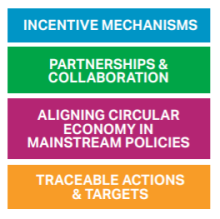
Effective policymaking is crucial to accelerate and scale up circular actions in the economy. It supports businesses in overcoming hurdles by stimulating innovative projects and long-term investments in circularity, facilitating collaboration and partnerships, and producing tangible results.
Learning from successful policies can help inform future policies to promote wider actions in other sectors and regions over time.
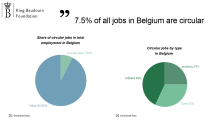
This report presents a baseline measurement of employment in the Belgian circular economy and provides insights into the nature and number of jobs in the country’s circular economy. This includes all jobs contributing to the circular economy through activities in renewable energy, repair and maintenance, recycling, digital technology, design, new business models and collaboration.
This report, conducted by the King Baudouin Foundation and the Dutch social enterprise Circle Economy, aims to inform governments, employers, social partners and other representatives with a view to pursuing effective and inclusive circular labour policy.
An online monitor, which the partners will update regularly, complements the report.
Over the last few years the concept of chemical recycling has been promoted by industry as a potential solution to help curb plastic pollution and waste management as a whole. This Zero Waste Europe report looks into the knowledge available as well as the state of implementation of such technologies in the European context.
Mechanical recycling is a mature industrial process, well established and expanding in Europe. Plastics cannot however be endlessly recycled mechanically without reducing their properties and quality. Besides, not all plastic types can be mechanically recycled. These limits set challenges for plastics recycling and show the need for significant improvements in the end-of-life management of plastics.
The New Plastics Economy Global Commitment unites businesses, governments, and other organisations behind a common vision and targets to address plastic waste and pollution at its source. It is led by the Ellen MacArthur Foundation in collaboration with the UN Environment Program. Launched in October 2018, the Global Commitment already unites more than 400 organisations in its common vision of a circular economy for plastics, keeping plastics in the economy and out of the ocean. Signatories include:
close to 200 businesses that are part of the plastic packaging value chain, jointly representing over 20 % of all plastic packaging used globally, including many of the world’s leading consumer packaged goods companies, retailers, and plastic packaging producers