The production of Portland cement (PC) is responsible for 8-10 % of the global anthropogenic CO2 emissions. PC and PC-based blends are the most common binder in concrete production (< 99 % of cases). As PC is accountable for 74-81% of the CO2 footprint, substantial climate impact reductions for concrete requires eco-innovation at the cement level.
One of the most promising technologies to lower CO2 emissions consists in partially replacing traditional PC with industrial byproducts displaying cementitious properties, such as blast furnace slag from iron production, or coal combustion fly ashes from power generation, but their availability and properties are rather constrained.
A diversification of local (secondary) raw materials to extend partial substitution of PC is ongoing.
This study aims to gain insight into how the transition to a more circular economy could impact the labour market, with a focus on net job creation or loss, job creation at different skill levels and geographical job concentration.
The methodology used was a combination of literature review and exploratory data analysis, the latter mainly focused on the Belgian region of Flanders.
It concluded that the transition will positively affect employment for vulnerable groups and reduce overall unemployment. The transition also has the potential to reduce the educational and geographical mismatches present in the Flemish labour market.
However, opportunities will vary between regions and the quality of jobs is key (some jobs in the waste sector are 'dirty jobs').
To evaluate the impact of adopting circular economy principles in cities – in terms of emissions, quality of life and resilience – Enel and ARUP, with the scientific support of the Enel Foundation, have collaborated on a research project focusing on four cities: Bogotá, Genoa, Glasgow and Milan, all committed to enhancing the energy transition.
The study concerns three key urban sectors:
mobility
built environment
energy systems.
It entailed interviews with stakeholders and analyses of existing decarbonisation policies and circular strategies. A reference model was used to help identify the most significant circular actions that could lead to a reduction in GHG emissions in three sectors.
The results could be used as a guide for decision makers.
Bocconi University’s analysis of 200+ European, publicly listed companies across 14 industries shows that the higher the circularity of a company, the lower its risk of defaulting on debt, and the higher the risk-adjusted returns on its stock.
The paper reveals how circular economy strategies can reduce investment risk by decoupling economic growth from resource consumption, diversifying business models, and allowing businesses to better anticipate stricter regulation and changing customer preferences. Embedding circular economy principles also reduces exposure to supply chain disruptions and volatility of resource prices.
Regenerating nature requires an economic transformation. To halt and reverse biodiversity loss, we need to fundamentally transform the way we produce, use, and consume our products and food. Conservation and restoration efforts alone – crucial though they are – will not be enough. The circular economy offers a framework for such a transformation. Applied together, its three principles are able to help tackle the root causes of biodiversity loss and enable the regeneration of nature. These biodiversity benefits can be demonstrated across different industry sectors, as shown in this new study by Ellen MacArthur Foundation. This paper also highlights the key steps businesses and policymakers can take to scale the circular economy potential and help shape a nature-positive future.
Given the need totake biodiversity more into account in circular economy projects, this study aims to stress the links between the two and to clarify the role played by the circular economy in preserving ecosystems.
Several guiding circular economy principles contribute to reducing the impacts of our activities on ecosystems, such as non-toxicity, optimisation of resource management, promotion of renewable resources and looping of flows. The study also highlights the fact that each lever for implementing the circular economy can and should factor in biodiversity: land-use planning, normative framework, innovation, awareness raising and training, and economic support.
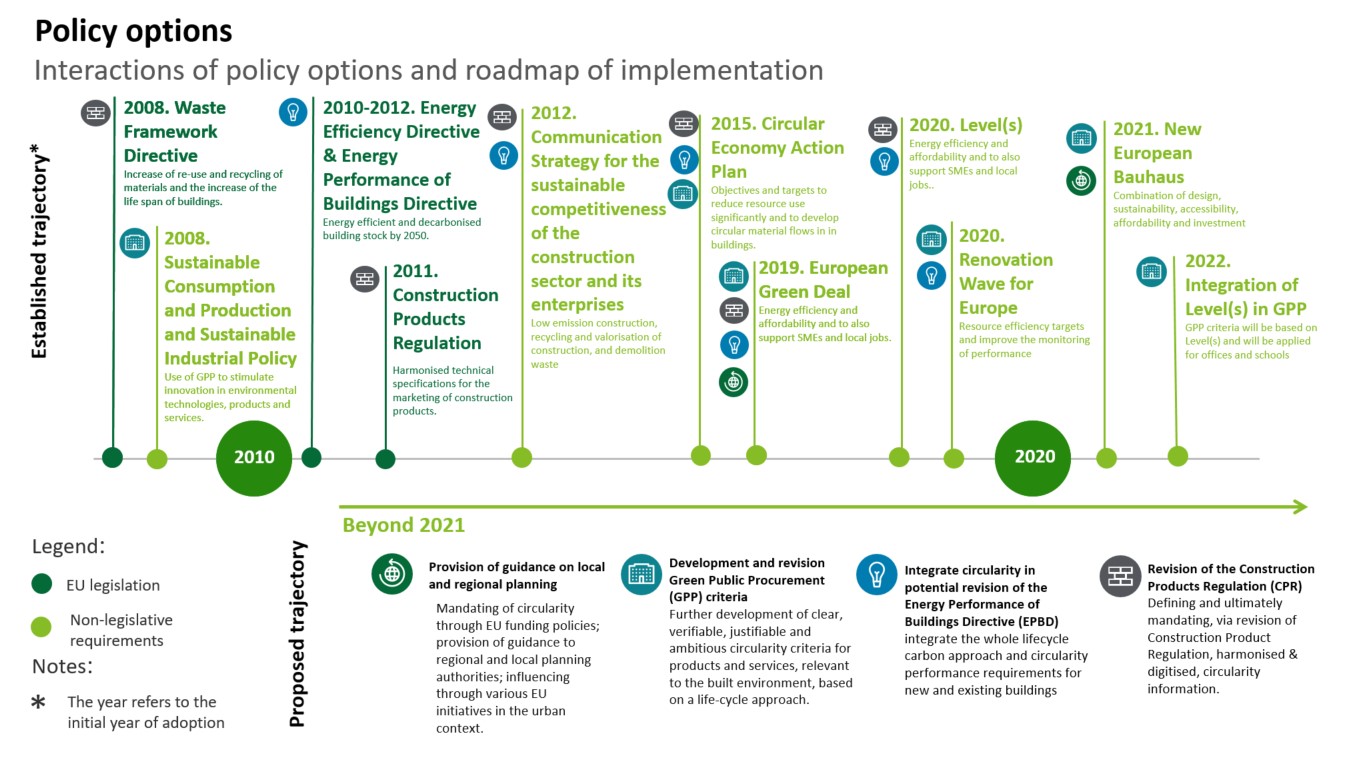
This study aims to assist the European Commission to identify policy options that support the uptake of circular economy principles for buildings’ design in European, national and local policies.
The goal is:
to increase the service life of buildings
to facilitate the use of secondary materials and
to improve resource efficiency across the building life cycle.
The study also provides key insights and recommendations on actions for a roadmap supporting the uptake and implementation of circular economy principles for buildings’ design.
Every year, about 100 billion tons of material are taken from the planet - but only 10 billion are circularized. The results of the TOP 10 study clearly highlight the differences between the systems: the waste culture and concepts are different in the Global North and the Global South, as are the objectives of the respective legislations.
In the Global North, the goal is to decouple waste generation from consumption. In the Global South, waste increases with per capita income; here, the old consumption patterns and images of the rich Global North are often emulated.
Scorecards are used in the study to assess individual materials and their circular maturity in the region. The overall score is shown in the summary per material.
This report is published by the Cyprus Federation of Employers & Industrialists (OEB), the Institute of Greek Tourism Confederation (INSETE) and the public policy consultancy adelphi (Germany) as part of the European project Hotels4Climate financed by EUKI.
The report aims to assess the current state of circularity in the hotel industry in Cyprus and Greece by conducting national surveys in both countries targeting hotels in order to:
identify the priority sectors within the main services offered by hotels, the business challenges and opportunities to move to circular economy,
create successful, flexible and resilient circular business models, and
identify a number of internal and external barriers that raise obstacles to the transition to circular economy.
The circular economy is an alternative to the dominant economic model, which causes considerable damage to the environment as it is based on the linear use of resources.
The development of the circular economy has been hindered by a number of economic, technological and regulatory constraints.
EpE's natural resources commission has spent three years identifying what makes circular economy initiatives successful. An analysis of 27 circular economy initiatives carried out by companies shows that partnerships are one key to overcoming these constraints. A closer examination of these partnerships sheds light on various forms of governance.