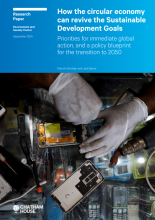
With progress on the UN’s Sustainable Development Goals (SDGs) badly off track, solutions are needed - and the circular economy has clear potential.
This Chatham House paper explores how the circular economy could support each of the 17 SDGs and argues for this concept to be put at the heart of emerging plans to drive sustainable development towards 2050.
It identifies five priorities for action: embedding principles of justice and inclusivity into the circular transition; increasing international policy coordination; reforming the financial architecture to ensure the circular economy gets the investment it needs; rewiring the global system of trade to make it easier to trade circular products and services; and developing common standards and metrics.
Come and find out about the report quantifying the socioeconomic benefits of the second-hand clothing sector in the European Union and the UK (EU27+), Ghana, Kenya and Mozambique. Its findings offer insights into the global circular textiles value chain, socioeconomic impacts and the policies shaping this crucial industry.
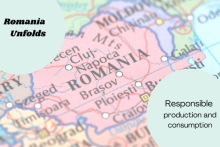
Romania Unfolds is a documentary series focusing on Romania's transition to a more environmentally-friendly model. Episode 3 looks at sustainable production and consumption, exploring a project supporting short food chains and a system of returnable packaging.
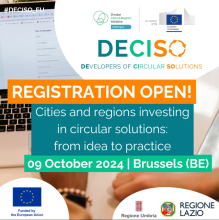
DECISO (DEvelopers of CIrcular SOlutions) is a Horizon Europe project running from 2023 to 2025 which will assist European cities and regions with developing financing schemes for circular economy initiatives. This year, its annual conference will focus on Cities and regions investing in circular solutions: from idea to practice.
The I AM CIRCULAR challenge is your opportunity to showcase your innovations and lead the charge in the circular economy. This is not just a competition: it's a celebration of transformative ideas that are reshaping our world. Apply by 15 November!
Join the first session of the B-Trust masterclass series on Unlocking Consumer Trust in Innovative Biotechnologies.
This session will explore how consumer trust affects biotech innovation in the agri-food and bio-based sectors. Gain insights into stakeholder engagement, risk communication and building public trust.
On 17 July 2024, the Catalan government launched the Roadmap for the Circular Economy in Catalonia (Full de Ruta de l’Economia Circular a Catalunya, FRECC), highlighting its push for sustainable development and accelerating the transition to a more circular and equitable economy that maximizes the value of resources by 2030.
The plan, developed by the Catalan government (Generalitat de Catalunya), experts and citizens, aims to decouple economic growth from resource consumption and greenhouse gas emissions.
The roadmap will be implemented by means of two action plans: one for 2024-2026 and another for 2027-2029.