The uptake of green and digital technologies will massively increase demand for critical raw materials (CRMs). Since CRM supply chains are heavily concentrated, this exposes the EU to significant CRM supply risks. Several policy options emerge for the EU to address these risks. Domestically, there is potential to produce primary and secondary CRMs, yet significant time and resources will be required to scale up production.
Material substitution and resource efficiency might also play non-negligible roles with enough R&I support. Internationally, both trade policy and international cooperation (including within multilateral fora) hold significant prospects for mitigating supply risks. If properly managed, stockpiling CRMs can also help shield against short-term supply or price shock.
What do consumers feel about upcycled food? Completing this FOODRUS survey by the University of Copenhagen takes only 5 to 7 minutes and will help design more sustainable food chains.
For the EU’s Green Deal to be effective, it is critical to target the root cause of the triple environmental crises of climate change, pollution and biodiversity loss: excessive extraction, production, manufacturing and consumption of material resources.
This excess is not evenly distributed in the world: as highlighted in the report, the EU consumes more than its fair share – levels that are almost double the estimated sustainable consumption levels.
Addressing material resource consumption by establishing an EU Material Resources Law will be critical to meet the fourfold objectives set out in the Circular Economy Action Plan (CEAP) and stay within planetary boundaries. The EU will not achieve its climate change targets without making progress on resource consumption.
The Joint Research Centre (JRC) of the European Commission has just published a report on construction & demolition waste (CDW) which confirms that the circular economy is crucial for reaching climate neutrality by 2050:
- construction & demolition waste accounts for almost 40% of all waste generated in the EU - the new JRC study estimates the potential for recycling and preparing for re-use of CDW to be roughly 83% - realising this potential would lead to an additional 33 Mt CO2e savings annually (equivalent to the combined annual emissions of e.g. Estonia, Latvia and Luxembourg).
The European Commission is taking important legislative and non-legislative steps to ensure CDW is managed in an environmentally sound manner and contributes to the circular economy.
The first step towards circular financing in the Nordics
The circular economy is a resource and energy-efficient economic model, built on high value retention in products and materials. It is suggested as a core strategy to tackle the climate and environmental crises that face humanity. Business models that promote and drive value retention play a key role to achieve a more circular economy, and for circular business to thrive, financing of these circular business models is a must.
The Transition Group for Circular Finance is a working group within the Nordic Circular Hotspot. It was initiated by RISE (Research Institutes of Sweden) and aims to address challenges and develop solutions for financing circular business models.
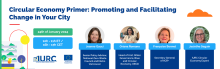
This webinar on 24 January will introduce key organisations and resources at the regional and national levels, as well as host a first discussion amongst participants on experiences, interests, and challenges for cities and regions to enable a transition to a circular economy.