Renewaball introduced the world’s first fully circular tennis and padel balls, designed with recycled materials sourced from used balls collected across European clubs.
This project embodies eco-friendly design by reusing rubber from old balls and using biodegradable wool felt to replace conventional polyester and nylon, which reduces microplastic pollution.
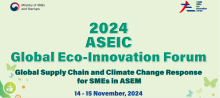
The ASEM SMEs Eco-Innovation Center will be hosting a Global Eco-Innovation Forum under the heading Global Supply Chains and Climate Change Response for SMEs in ASEM.
The forum is a unique opportunity to explore the latest strategies enabling SMEs to respond to climate change and adapt to global supply chain regulations. It will provide insights into supply chain regulations and climate change responses for SMEs and startups.
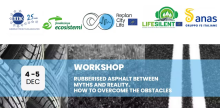
Both the RE-PLAN CITY LIFE and LIFE SILENT projects support the use of recycled rubber in asphalt. Experiences and demonstration projects in various countries have confirmed that this solution is technically viable and more sustainable.
This workshop will involve a visit to an asphalt plant which produces and lays rubberised asphalt and a seminar exploring the most recent experiences and innovations in the use of recycled tyre materials in asphalt and road infrastructure.
INN-PRESSME helps European SMEs and companies develop bio-based solutions in the packaging, energy, transport and consumer goods sectors. They are organising a webinar to provide information about their services, test cases, new opportunities to test-before-investment, and network with industry players. The webinar will focus on transport and consumer goods.
Businesses in India and around the world are adopting the circular economy as a new production paradigm. However, while the economic and environmental dimensions of the circular economy have been explored, its social impact (decent pay, gender equality, labour conditions) has been overlooked.
By surveying 100 workers and interviewing 40 managers in India, the authors developed an inventory of circular jobs with the respective demographic. They found that circular jobs in India are of low quality due to relatively low wage and job security indicators (especially for female workers). Informal migrant women in resale, repair and recycling are most vulnerable. Resale and rental based on internet platform models have the highest earning quality for men and women.
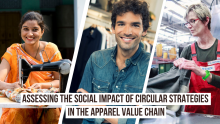
The apparel value chain is essential for the livelihood of millions of workers around the globe, but working conditions in this sector are far from satisfactory. The circular economy has been used by businesses as a framework for achieving sustainability but there is a lack of knowledge about its social impact.
This paper explores the social impact of the different circular strategies implemented in the Netherlands, Spain and India. It assesses social impacts related to the quality of jobs, workers’ sustainable livelihood and gender equality and inclusion.
It finds that the social ambition of the circular economy is low, and that current circular strategies follow the same feminisation and precariousness of working conditions found in the linear apparel value chain.