The CCRI hands-on online workshops will focus on a key implementation challenge identified in the CCRI communities of practice. They will translate those insights into practical tools, methods and examples that participants can apply in their own context.
This session will look at Consumption‑based emissions (CBE) which show the climate impact of what cities consume, not just what they produce. It will introduce what a Consumption‑Based Emissions (CBE) inventory is, what it can (and cannot) tell you, and how cities are beginning to use CBE insights to inform circular economy action.
The CCRI hands-on online workshops will focus on a key implementation challenge identified in the CCRI communities of practice. They will translate those insights into practical tools, methods and examples that participants can apply in their own context.
This session will focus on how planning can support the reuse of existing assets, limit land take, reserve space for circular activities and create the right conditions for circular design and material use in new developments.
The CCRI hands-on online workshops will focus on a key implementation challenge identified in the CCRI communities of practice. They will translate those insights into practical tools, methods and examples that participants can apply in their own context.
This session is based on the community of practice Supporting local circular businesses. It will focus on designing support measures for circular businesses that work in practice.
Building on its previous collaboration with the European Remanufacturing Council, Ihobe, the Basque Country’s Environmental Agency, has developed and published the Remanufacturing Maturity Level Evaluation Guide.
This manual will contribute to the ongoing development of the new European CEN standard on Remanufacturing – Classification of the quality of circular processes.
Why does the EU–Australia relationship matter more than ever?
Because this is no longer just about trade. It is about resilience, access to resources and the ability of like-minded partners to navigate a volatile world together.
Join us for an EU Circular Talk exploring how the evolving EU-Australia partnership — shaped by trade negotiations, climate commitments and shifting geopolitics — is becoming a testing ground for the circular economy as a strategic framework.
The MAGNO project aims to promote the adoption of solutions reducing the impact of plastic food packaging pollution in ecosystems.
In order to achieve this, it is designing ecosystem digital twin software which enables innovative ideas to be tested and refined before being implemented in the real world.
Looking for projects developed by students from universities and vocational training centres across Europe!
Projects must demonstrate innovation in business models, products, services or industrial processes under circular economy criteria, and have real potential to develop new business opportunities.
With a focus on the future Circular Economy Act and on optimising WEEE recovery, this high-level event will explore how innovation, policy and collaboration can accelerate a more circular electronics sector and support Europe's clean transition.
360° Foodservice is the collaborative platform dedicated to promoting the sustainable service of food and beverages across Europe.
It encompasses the whole supply chain of the foodservice packaging sector, from manufacturers to end-of-life solution providers. It unites companies that provide reuse and/or single use solutions for safely serving food and beverages to millions of Europeans every day, regardless of the materials that are used.
Collection and recycling must be in place for single use items once they have done their job. Reusable items must be collected and sanitised before being used again, and recycled when they reach the end of their useful life.
Members work towards promoting the sustainable evolution of single use and reuse systems for serving food and drinks in Europe.
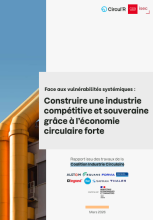
The Circular Industry Coalition, led by Circul’R and CEA ISEC with the support of the French Ministry of Economy and Finance, brings together nine major industrial companies to address the growing systemic risks facing European industry.
After a year of collective work, the coalition has published a report highlighting the limits of the linear model and positioning a strong circular economy as a strategic lever for competitiveness, resilience and industrial sovereignty.
The report provides a shared assessment of industrial vulnerabilities and an operational roadmap to accelerate circular transformation at scale.