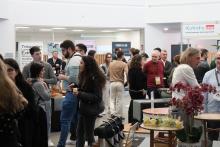
WASTELESS is an applied research project, which aims to measure and monitor food losses and waste in the EU. It will be hosting a series of interactive workshops showcasing the innovative tools developed within the project to tackle food loss and waste across the entire value chain.
This session will focus on Surplus stock measurement and management.
In a changing political landscape, the implementation of circular economy strategies presents significant potential for reducing greenhouse gas emissions, decreasing fossil fuel use and altering trade dynamics. Circular economy strategies related to material reduction, reuse and recovery complement industrial decarbonisation measures and have the potential to double GHG savings by 2050.
Through a multi-method analysis, this study shows that an ambitious circular economy scenario can yield substantial annual GHG savings across selected energy-intensive sectors and decrease EU imports, reducing trade dependency and increasing the trade balance by over EUR 30 billion compared to the decarbonised baseline.
This workshop will bring together six EU-funded projects representing an ecosystem of 80 organisations driving innovation towards catalyst circularity and greener production in the EU.
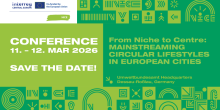
This workshop will explore how sustainable urban development can unite environmental responsibility, economic resilience and social well-being, transforming cities into ecosystems that regenerate rather than deplete.
The EU-funded REFRESH project is organising a webinar to present its progress in developing innovative technologies for recycling end-of-service wind turbine blades.
This webinar will explore the challenges women face in leadership roles within the furniture industry. It will also highlight training tools and initiatives that foster equality and empowerment, with a special focus on how women leaders can drive sustainability and circular economy practices in the sector.
This report addresses the question of whether Flanders, with its limited space, will be able to produce enough biomass in the future to supply the bioeconomy and continue to feed the increasing population.
Four scenarios were used, providing insight into the demand development for biobased raw materials for feed, food, fuel and fibre.
It found that:
An open economy, with international imports/exports of bio-based raw materials, is crucial for a small, densely populated and prosperous region like Flanders.
Long-term collaboration with other regions and countries is a strategic necessity. The energy transition, protein shift and circular transition must be streamlined to run synergistically. This can reduce the pressure on raw bio-materials.
eBay's second Circular Economy Roundtable will bring together policymakers, industry leaders and civil society to discuss the crucial role of the global second-hand trade in achieving the EU's green and digital transition.
Key topics will include aligning EU legislation with circular economy goals, reducing barriers to second-hand trade and building consumer trust. The roundtable will feature the launch of a new study on second-hand trade commissioned by eBay.
The European Environment Agency (EEA) has just published a report on 'Europe’s environment and climate: knowledge for resilience, prosperity and sustainability'. It is the most comprehensive analysis of the state of play of and outlook for the continent’s environment, climate and sustainability, building on data from across 38 countries.