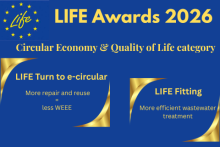
The LIFE Awards 2026 included the Circular Economy & Quality of Life category.
The winner proposed a replicable way to reduce the amount of WEEE generated, and one of the runners up designed tools to optimise wastewater treatment while reducing waster consumption.
VA TechTrade buys back used laptops, tablets, phones and computers, refurbishes and quality-tests them to a verified working standard, and resells them with a warranty to customers across the EU.
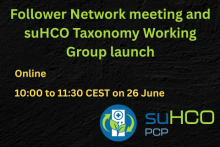
suHCO addresses the common challenge of accelerating the sustainability transition in the healthcare sector through a Horizon Europe Pre-Commercial Procurement process.
This workshop will introduce the suHCO project and its procurement approach, and outline the planned role and benefits of the Follower Network.
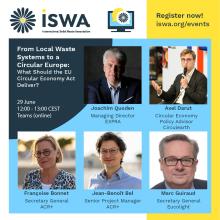
This webinar will discuss what the Circular Economy Act should deliver from a practical waste-management and implementation perspective.
It will look at how local waste systems, circular economy policy and producer responsibility schemes can better support Europe’s transition towards a circular economy.
On 10 June, the European Commission presented three new initiatives to boost EU's bioeconomy sector.
This launch includes
the Bio-based Europe Alliance (BEA) to support market scale-up,
the Bioeconomy Investment Deployment Group (BIDG) to improve access to finance,
and the Expert Group on Bioeconomy to support implementation by Member States.
As part of the launch comes a call to join the Bio-based Europe Alliance, to support European companies in reaching marketability for their bio-based products. Apply by31 July!
On 28 May, CircEUlar, CIRCOMOD and CO2NSTRUCT held their joint final event.
It was pointed out that material recovery and recycling are not enough: sufficiency measures, service-focused solutions, lifetime extension, digitalisation and behavioural change will all help Europe move further and faster towards net-zero. Read about what else was discussed!
On 10 June, the EU's MEP Group on Climate Change, Biodiversity & Sustainable Development held a meeting on Navigating the Circular Economy Act: Implications and opportunities for a sustainable EU.
Speakers discussed what the CEA aims to achieve and what gaps need to be addressed.
The Joint Initiative on Circular Economy (JICE) brings together the EU’s largest public promotional banks and institutions.
Against the backdrop of the expected EU Circular Economy Act and a shifting regulatory environment, JICE is launching a webinar series to deepen market understanding of financing needs, gaps and bottlenecks for the circular economy across selected sectors.
The Joint Initiative on Circular Economy (JICE) brings together the EU’s largest public promotional banks and institutions.
Against the backdrop of the expected EU Circular Economy Act and a shifting regulatory environment, JICE is launching a webinar series to deepen market understanding of financing needs, gaps and bottlenecks for the circular economy across selected sectors.
This webinar will focus on critical raw materials from e-waste.