EuRIC, a leading voice in Europe's recycling industries, is organising an event on "Plug into sustainability: e-waste recycling", to take place on 3 June from 14:00 to 17:30 CEST, in Brussels.
It will be an opportunity to explore the latest developments and sustainable practices in e-waste recycling, bringing together industry leaders, policy makers and innovators.
The GO-GRASS final event will be a chance to discuss the project's final results and the implications for grass-based businesses in a future bio-based economy. It will feature a session on circular business models and technologies developed by the project, two policy panels with high-level representatives from EU, national and local level stakeholders and an excursion to a grass-based paper production facility in the Netherlands.
Are you interested in how digitalisation can support the circular economy? With Digital Product Passports (DPP) coming into force in 2027, and gradually expanded to a wide scope of product groups, this event will contribute to your understanding of DPP deployment.
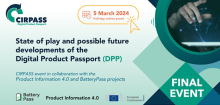
This CIRPASS final public event on 5 March 2024 will bring together European industries, policymakers, R&D centres, standardisation organisations, circular economy and sustainability actors and digital solution providers to learn more about the current state and possible future developments of the Digital Product Passport (DPP).
In this podcast episode the Conference Board talks to the European Commission's Malgorzata Golebiewska about the EU Green Claims Directive and its goal of preventing greenwashing and rebuilding consumer trust. Listen to the new podcast!
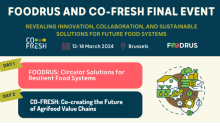
The final events of the FOODRUS and CO-FRESH projects will take place together in Brussels on 13 and 14March. It'll be an opportunity to explore and discuss the innovative solutions that the two projects have come up with, with a view to shaping the future of food systems.
Would you like to help implement and monitor the Transition Pathway for Construction, and have the chance to take the stage during the fourth annual plenary meeting of the High Level Construction Forum? Share your commitments for actions through a survey!
Take part in the high-level event organised by the European Commission as part of the Bioeconomy Changemakers Festival!
This high-level event is part of the Bioeconomy Changemakers Festival, a collection of events organised by the European Commission (DG Research and Innovation) in cooperation with the Bioeconomy Youth Ambassadors from 11 to 17 March.
Along with the high-level event, the festival will comprise over 30 satellite events organised by third party organisations all over Europe. The festival aims to engage young people as drivers of the transformative change needed to address the multiple challenges facing Europe and to unlock the potential of the bioeconomy to make that transformation happen.
A Digital Product Passport (DPP) is being discussed as a core instrument for building a circular economy, itself a key enabler of climate neutrality. Although there is not yet a standardised, cross-sectoral and cross-company product passport system, there are already individual solutions for collecting information for certain product groups.
A DPP needs to be made available digitally for all stakeholders in order to increase transparency throughout the entire product lifecycle.
This paper answers the following questions:
Why are politicians pushing for a DPP in connection with the circular economy?
What is a DPP?
What already exists?
What does a DPP need?
How ready are companies for a DPP? How can a DPP be delivered?
Find out about P2GreeN, a four-year Horizon Europe project developing, testing and adapting the use of human waste to produce safe, bio-based fertilizers for agriculture!
Municipalities are seeking to reduce waste generation and increase recycling rates in order to cut greenhouse gas emissions. Materials that evade recycling are typically landfilled or incinerated.
This study compares cost effectiveness between sorting of mixed waste leftover after separate collection (leftover mixed waste sorting) and the capture of CO2 from incinerator flue gas for underground storage (carbon capture and storage, CCS).
It has found that the most cost-effective way of delivering system-wide reductions in CO2 emissions is the sorting system. The least cost-effective means to reduce CO2 is CCS. Combining the two would achieve the greatest overall reduction and reduce the average cost of reduction to around half the cost of achieving reduction through CCS alone.