The Global Summit on Environmental Science and Engineering will present the most recent developments in this field, with highly cited researchers, industrial leaders and exhibitors sharing their research. The sessions will cover topics such as waste-to-energy conversion, landfill management and waste management.
Join the Global Green Action Day initiative tackling plastic pollution through collaboration, innovation and action.
Held in support of UN World Environment Day on 5 June, this initiative has a twist: because this is a complex challenge, you can only participate if you have completed the online training, which includes lessons, expert panels, guest talks and webinars.
The European Training Foundation has launched the fifth Green Skills Award, an annual competition designed to provide ideas and inspiration for policy makers and practitioners on how things can be done when it comes to green skills deployment and promoting sustainability.
This report describes what Circle Economy achieved in 2024.
In 2024, they rolled out a new approach to delivering impact which focused on three key objectives to accelerate the global transition to a circular economy: empowering decision-makers (they provided indicators and evidence to ensure accountability in circular economy ambitions), financial support for solutions (they raised sufficient financial capital for circular and just solutions) and building capacity (this involved equipping key actors with the tools needed to implement circular solutions).
The report gives figures to describe their impact. For instance, they have directly supported over 970 businesses and organisations and trained over 7200 people in circular economy principles.
The World Circular Economy Forum is one of the biggest circular events of the year. WCEF2025 will take place in São Paulo, Brazil on 13-16 May under the heading Tropical solutions for sustainable growth!
The programme has now been released, with a rich selection of plenaries and parallel sessions.
Do you have a business model, method, process or technique that’s making a difference in reducing waste within the fashion and textile sector? Then tell UNEP and UN-Habitat about it!
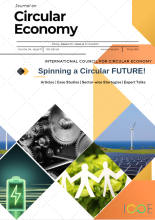
The Journal on Circular Economy is an initiative by the International Council for Circular Economy (ICCE). The journal explores various dimensions of the circular economy, including policy frameworks that support sustainable practices, research initiatives that drive innovation, and collaborative efforts that foster knowledge sharing among stakeholders.
The January 2025 edition features an article by Freek van Eijk from Holland Circular Hotspot, one of the ECESP Coordination Group co-chairs. The article focuses on the Netherlands: embracing circular economy as a business opportunity and a necessity. It looks at the origin and future of circular economy developments there and what lessons might be learned for India.
SUM 2025 aims to promote more continuous interaction and collaboration across fields, encouraging sustained, multidisciplinary dialogue and strategic partnerships.
The network properties of the global waste trade were assessed using time series data of material and monetary flows between 2000 and 2022 from Chatham House's experimental database. The study focused on the distribution of monetary and material flows, policy recommendations and future research avenues useful for obtaining a more comprehensive understanding of socio-economic systems such as trade networks.
This work is a solid example of the application of network-based methods as an eco-mimicry approach for assessing the sustainability and fragility of socio-economic systems which can be helpful for researchers and policy makers interested in transitions towards regenerative circular economies.
Filippos K. Zisopoulos, Brian D. Fath, Susana Toboso-Chavero, Hao Huang, Daan Schraven, Benjamin Steuer, Alexandros Stefanakis, O.Grant Clark, Serban Scrieciu, Simron Singh, Dominik Noll, Martin de Jong
This study assesses the network properties of the global trade in waste metals and the distribution of material and monetary flows across trading countries using a bio-inspired approach.
Due to homogenization, high network redundancy and low network efficiency, the trade remained robust yet outside the "window of vitality" characterising natural ecosystems. A few, mostly high-income countries dominated the market, consolidating imports of high-value metal waste, mostly from low- and middle-income exporters.
Policies should address circularity and trade inequities, accounting for environmental and social ramifications throughout the lifecycle of products and materials.