NP-bioTech uses a biocatalyst, adsorbed onto an inert material (catalytic substrate). This enables the accelerated fermentation of critical biomass (such as citrus pulp or sewage sludge), transforming it into a biostabilised and pasteurised material with excellent agronomic properties.
The Hydro Ben project focuses on resource recovery for reuse in other industrial activities. It consists of recovering fatty substances from wastewater in professional catering facilities, by means of a special device which is placed under the sink.
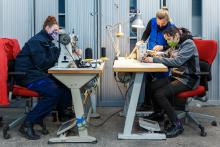
remesh is a socio-professional business workshop with an environmental impact. Most of its employees are women from disadvantaged background. The workshop is also providing a circular economy business model as they reuse advertising banners and meshes to make new products that are fashionable but sustainable.
ROCESP members include local and central government institutions, academic, research and innovation institutions, businesses and civil society representatives.
The platform acts as a network of networks, bringing together initiatives, experiences, problems and expectations in the field of the circular economy.
The platform:
disseminates knowledge
promotes dialogue and synergies between Romanian stakeholders
maps good practices in Romania
helps establish links between national projects
shows how Romania has adapted its economy to become more circular.
Ireland is at a turning point for the transition to a circular economy (CE). The 2022 Whole of Government Circular Economy Strategy provides the policy framework for the CE in this country, and the forthcoming Circular Economy Bill is expected to strengthen waste and CE legislation.
Nevertheless, with a circularity material use rate of 2% in 2020, Ireland shows significant scope for progress. This report analyses the state of play and challenges of the circular transition in Ireland and provides policy recommendations for CE policy across levels of government. It is the result of a two-year policy dialogue between the OECD, the Department of the Environment, Climate and Communications, as well as a broad range of public, private and civil society stakeholders.
This report, prepared by the Dutch Ministry of Infrastructure and Water Management, provides an analysis of the Dutch procurement system.
The Dutch Sustainable Public Procurement (SPP) approach embraces six themes, two of which are explored in this study: climate-neutral procurement and circular procurement. Included in these two themes are aspects such as CO2 and other greenhouse gas emissions, as well as the reuse of raw materials at the highest possible level of value.
SPP is a highly topical issue for a steadily growing number of organisations in the Netherlands: action plans are being written, requirements and criteria are being formulated, and tools are being produced. Together, these activities are creating growing demand for instruments that evidence the impact of SPP.
France's Law Against Food Waste has become an international model for sustainable food policy. The law is often described as combining economic efficiency with environmental protection and social equity. However, stakeholder narratives cast doubt on whether this French CE law really contributes to social justice in the long run. This discourse analysis shows that:
the ban on food waste institutionalised a narrative about food waste that prioritises profit over social equity
the traditionally dominant solidarity narrative about food waste has been pushed back by the emerging CE discourse
As a consequence of this shift, activities enacted in the name of the CE may counteract social equity goals (for instance by establishing competition with charities).
Policies are focusing on halving food waste to help conserve increasingly strained food resources. However, expanding their scope of action to include dietary changes and complement targets with resource footprints has greater potential to save resources while avoiding trade-offs.
This paper shows that in Germany:
Healthy, plant-based diets are more effective at reducing land and biomass use than halving food waste
A combination of more plant-based food consumption and food waste reduction in distribution and consumption is most effective at saving resources
Focusing exclusively on food waste reduction as a policy target can be detrimental to the overarching goal of saving resources because it deflects attention away from more effective alternatives.