This event aims to familiarise people with the Guidance on increasing NDC (Nationally Determined Contributions) ambitions through circular action and the related Activity Sheets, drawn up by the German International Cooperation Society's global Go Circular programme. It will highlight their role in enhancing climate ambitions through circular economy measures.
On 1 November, the ECESP's Leadership Group on Biodiversity & Climate, in cooperation with the European Economic and Social Committee (EESC), the International Union for Conservation of Nature (IUCN) and the Ellen MacArthur Foundation (EMF), organised a COP16 side event exploring Towards a circular economy in harmony with nature.
This was the last side event hosted at the EU Pavilion, but it still attracted a high level of interest and participation. The recording of the session is available – have a listen!
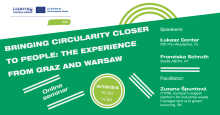
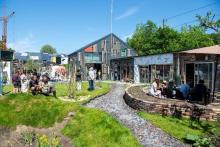
This online seminar explores how to empower residents of European cities to adopt more circular living practices. It will delve into initiatives successfully implemented in Austria and Poland.
The Circular City Centre (C3) is a competence and resource centre led by the European Investment Bank and co-funded by the European Commission as part of the Circular Cities and Regions Initiative. To support EU cities in their transition to a circular economy, C3 offers two advisory programmes, the Circular City Advisory programme and the Circular Project Advisory programme.
The Circular City Centre (C3) is a competence and resource hub within the European Investment Bank, funded by the European Commission as part of the Circular Cities and Regions Initiative (CCRI). It supports EU cities in their transition to a circular economy by offering tailored advisory programmes.
This Q&A sessionwill answer your questions about C3's advisory programmes.
The World Circular Economy Forum 2025 (WCEF2025) will take place in South America. It will explore the potential of tropical solutions for sustainable growth, the power of regeneration and bioeconomy strategies, along with how the production sector is driving the transition toward a circular economy. The forum will also address key topics relevant to Latin America and the world.
Accelerator sessions will be held by WCEF collaborators on 15 and 16 May.
Up2Circ (Boosting the uptake of circular business model, product and process innovation) is an international project funded by the Horizon Europe programme which aims to accelerate and scale up the transition of European SMEs towards a circular economy.
Resources without identity become waste, and this issue must be tackled in order to foster the circular economy. This webinar will discuss methods for assigning appropriate information to goods, tracking them and then processing and transfering this data efficiently, using state-of-the-art technologies such as AI, visual tracking systems, the Internet of Things and common communication languages.
Berlin began its circular economy transition in 2020 with the adoption of the Waste Management Concept 2020-2030, aiming to implement measures to reduce household, water and construction waste. To advance this transition, it established the Coordination Office for Circular Economy, Energy Efficiency and Climate Protection in Business in 2022 and the Zero Waste Agency in 2023, and commissioned a study to analyse the circular economy’s potential in the industrial sector.
Despite these efforts, the circular economy in Berlin is still often perceived only in terms of sustainable waste management. This paper looks at challenges holding back progress on the circular economy, including policy coherence, and provides recommendations to accelerate the transition.
Multilateral development banks have a key role to play in supporting and financing circular approaches. Recognising this, a group of these banks came together to discuss how to better support the circular economy and promote an exchange of knowledge with the private sector, civil society, and local, regional and national authorities.
This report is a result of their work. It presents 20 case studies from around the world that highlight the kinds of support on offer, such as advisory activities, public-sector lending, private-sector investments and backing for the financial sector. Sharing these experiences is important for identifying and adopting successful approaches that can be replicated and scaled up around the world.
This webinar will delve into recommendations for unlocking funding for circular economy projects. It will analyse the regulatory, market, social and technological barriers hindering the scaling and replication of circular economy models, and discuss strategies to overcome these challenges. By sharing lessons learned from successful EU initiatives, participants will gain insight that will enable them to replicate these initiatives in their own regions and cities.