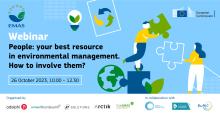
Since its inception, the EU Eco-Management and Audit Scheme (EMAS) has sought to be a tool to help companies reduce their environmental impact and gain acceptance in their area by being transparent about their environmental performance and maintaining an open dialogue with stakeholders.
But how can you involve staff in environmental management?
How are the EMAS tools helping to involve staff and top management in reducing environmental impacts and enhancing resource efficiency?
What good practices has EMAS identified for involving employees and stakeholders in its 30 years of experience?
Do people recognise the importance of their day-to-day behaviour in achieving environmental improvements at work and at home?
To answer these questions and have an interesting discussion with the audience, EMAS and ECESP organised a webinar on 26 October 2023, to learn more about EMAS and the importance of involving staff, top management and stakeholders in the circular transition.
On 6 November 2023, Arthur ten Wolde, ECESP Coordination Group member and Executive Director of Ecopreneur.eu, represented the Platform at a G7-B7 online meeting on Circular Economy and Resource Efficiency Principles. Mr Ten Wolde has been a member of the European Circular Economy Stakeholder Platform since its foundation in 2017.
The meeting was organised as part of the G7 Sapporo Ministers’ Meeting on Climate, Energy and the Environment in Japan. The Group of Seven (G7) is an intergovernmental political forum consisting of Canada, France, Germany, Italy, Japan, the UK, the USA and the EU. TheBusiness7 group (B7) is the G7 platform for dialogue with the international business community, consisting of the industry and employers’ associations from the G7 including BusinessEurope.
ECO-FUTURE is a 24-month school education cooperation partnership aiming to create an effective programme for teachers to educate children on the circular economy. The project was inspired by the COVID-19 pandemic, which highlighted the need to re-evaluate and redesign current methods and systems.
The project seeks to get students, schools and communities interested in sustainability, encouraging them to act responsibly at individual, community and global level, now and in the future.
A training course is being organised in Vantaa, Finland from 30 October to 3 November. It's designed for over 15 teachers from Finland, Italy and The Republic of North Macedonia.
The European Commission has worked on a web-based calculator to increase the awareness of EU citizens on their environmental impact as consumers. The Consumer Footprint Calculator allows EU citizens to calculate the environmental impacts of their consumption pattern, as well as to evaluate how changes in their lifestyle may affect their personal footprint. This tool is available in English, Spanish and Italian.
On 12 October, World Ecolabel Day, the European Commission released statistics showing that the EU Ecolabel – the official voluntary ecolabel of the European Union – is flourishing, with almost 90 000 certified goods and services in 25 different product groups available on the EU market.
On 29 September - the International Day of Awareness of Food Loss and Waste convened by the Food and Agriculture Organization - the European Food Information Council (EUFIC) launched a one-month food waste campaign, together with a new quiz on Evaluate Your Food Waste Practices!
The quiz provides personalised tips encouraging people to take simple steps at home. It's intended to help identify what kind of information they need to reduce the amount of food they waste. Once people have a better understanding of how to reduce food waste, they'll feel empowered to act.
In recent years, the concept of green jobs has been the focus of increasing attention. The principles of green jobs and green employment are grounded in a variety of evolving concepts such as green economy, green growth, sustainable development and circular economy, which are multi-dimensional and their understanding evolves in both academic and political contexts.
At the EU policy level, the green transition is seen as an opportunity to create jobs in existing and emerging economic sectors. A large number of different approaches to how green jobs can be defined and classified have been put forward. Differences and gaps identified in these existing definitions and frameworks have exposed the need to create a novel, integratedtaxonomy for green jobs, which is developed in this report.
Europe and the world face unprecedented sustainability challenges, largely as a result of unsustainable consumption. Since similar consumption patterns are expected to continue, technological and efficiency gains are likely to be insufficient to keep environmental and climate pressures within sustainable limits.
A more circular economy in Europe has the potential to reduce environmental and climate pressures and impacts from our consumption, but will require reshaping our consumption and production systems. This report presents trends in European household consumption and its environmental and climate pressures, and explores conditions for and pathways to a transition towards more sustainable and circular consumption patterns in Europe.
The World Resources Forum ’23 will take place in Geneva and online on 4-6 September 2023, enabling stakeholders to explore some of the key topics around sustainable resource use from the perspective of sufficiency, value chains and digitalisation.
A virtual side session on Circular Economy in Asia, Africa and Europe: sharing knowledge that makes value chains circular will be hosted on 7 September. It will focus on leveraging expertise and experiences from Circular Economy Stakeholder Platforms in ASEAN, Africa and Europe.
Do you know any outstanding organisations dedicated to awareness raising and citizen engagement on the circular economy? As CE experts and members of the circular community, you are invited to share links and insights into these Centres of Excellence via a survey which is being carried out by the Citizens Engagement and Behaviour Change Leadership Group.