The European Commission is opening a call for membership applications for a new Ecodesign Forum under the Ecodesign for Sustainable Products Regulation. The forum will play an important role in the implementation of the ESPR by involving all stakeholders in developing rules for more circular, energy-efficient and sustainable products.
The European Commission's Joint Research Centre is organising a second consultation meeting with stakeholders as part of its ongoing work on a preparatory study on textile products. This will support the implementation of the recently adopted Ecodesign for Sustainable Products Regulation.
CIMPA (A CIrcular Multilayer Plastic Approach for value retention of end-of-life multilayer films) is an EU-funded H2020 project working on developing a recycling value chain for post-industrial and post-consumer multilayer films (from food and agricultural applications).
The project will shortly be holding its final event where it will showcase its key findings. There will also be information on clustering initiatives on circular plastics and recommendations from policy makers, industry leaders, researchers and NGOs on unlocking the potential of plastic film recycling. The event will conclude with an opportunity for networking and a poster session highlighting new technologies which can enhance plastics recycling.
SUSTAINair was an H2020-funded project developing circular economy principles for the aviation and aerospace design, manufacturing, operations and end-of-life phases.
A tradition since 2019, the Business Council for Sustainable Development in Hungary (BCSDH) organises the Circular Economy Summit every November with the Dutch Embassy in Hungary. This year's conference will focus on the shift to a circular economy and international and domestic best practices.
The European Commission's DG Environment is organising an online conference exploring Level(s), the EU common language for assessing and measuring the sustainability performance of buildings. It's intended for anyone working in the built environment sector.
The Level(s) foundations conference will enable participants to get informed, get inspired and get started with the EU approach to building sustainably.
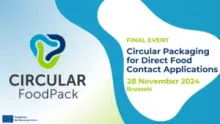
Over the last 3 and a half years, the CIRCULAR FoodPack consortium has worked on circular design for flexible packaging. It has demonstrated the various steps required to obtain post-consumer recyclates and shown how to integrate them into new packaging which meets the high standards for food protection and safety.
Attend their final event and see what they learned!
Up2Circ is an international project funded by the European Commission’s Horizon Europe programme. The overall aim is to help European SMEs go circular.
The project assists SMEs: there are awareness-raising and training modules and information on how to apply for EU funding. The platform has prepared a catalogue of its success stories.
The platform is also building a network of stakeholders: people with access to many SMEs, expertise in a given sector and/or the circular economy, advanced technologies or social innovation. These people will have access to Up2Circ's tools for helping SMEs.
The website also has information on circular events. The project organisers have experience with assisting SMEs; with this project they are focusing on the circular dimension.
CIRCULÉIRE, Ireland's National Platform for Circular Innovation, will be holding its annual conference under the banner The Future of Business is Circular.
The conference will focus on Pathways to 2030 decarbonisation, Building future markets and Showcasing industrial circularity. It will bring together leaders in climate innovation, policy and government to discuss circular advancement in Ireland.
This paper reviews digital tools that support the transition to a circular economy in the built environment.
It explores how computer-aided design, building information modeling and computational plugins can assist architects and engineers in creating more sustainable buildings. While Life Cycle Assessment (LCA) remains the main approach for evaluating environmental impacts, the study highlights other methods and tools that can help assess circular design strategies, such as computational methods to design with reused elements and circularity indicators. The paper identifies both the strengths and limitations of these digital tools.
This research is useful to academics and to practitioners designing buildings aligned with circular economy principles.