This webinar will present the main findings of Zero Waste Europe's latest study, prepared by CE Delft. The study explores the environmental impact and circularity of the different allocation rules for recycled content from multi-output recycling technologies, specifically pyrolysis and gasification.
For the eighth time, the Cradle to Cradle NGO is inviting 1000 participants to come and debate and network at the International Cradle to Cradle Congress 2023 on 8 and 9 September.
The Congress will feature panel discussions with high-profile speakers from business, politics and science, good practices from established companies and start-ups, inspiring keynote speeches about the circular transformation of our society and many opportunities for networking.
Tyres are complex products essential to the mobility of millions of Europeans. Likewise, tyre recycling is essential to the sustainability of the entire tyre value chain, be it in terms of resource efficiency or climate neutrality. Yet, despite a landmark landfill ban in 2006, much needs to be done to improve the circularity of tyres. To give an order of magnitude, today, for one tyre that is recycled, one tyre gets incinerated for energy recovery, and the worse in terms of end-markets opportunities is yet to come.
The EuRIC conference on tyre recycling takes place in Brussels on 18 April 2023.
We must better link the EU circular economy agenda with food security and safety-related challenges. The packaging industry can support the EU's sustainability ambitions for recyclable packaging by encouraging innovations and circular actions along the whole value chain.
How can the revised PPWD secure investments in sustainable food packaging solutions? And what role can consumers play when it comes to the implementation of the PPWD in practice? These are some points to discuss on 6 September 2023 from 10:00 during the #EUCircularTalks.
The D-CARBONIZE project is kicking off by recruiting 12 doctoral candidates for training on using biomass to produce bioplastics. The candidates will learn how to use circular chemistry to develop monomers from biochar sources for use in the production of recyclable bioplastics.
Coordinated by the ICIQ, the D-CARBONIZE Project is part of Horizon Europe's Marie Skłodowska-Curie actions and is a consortium of 12 partners.
Interested in circular plastics? Join the interactive webinar "A Circular Economy for Plastics in Canada & the Netherlands" on 5 April to learn more about current policy approaches, best practices, latest technologies and market opportunities in the Netherlands and Canada.
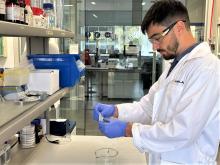
The Swedish company Re:Lab AB has developed a chemical circular economy solution to convert plastic items used in research laboratories into a syngas comprised of carbon monoxide and hydrogen. These two components are in high demand for the production of chemicals and plastics.
The European Commission is conducting a survey on possible new legislation on the management of plastic pellets, with a view to reducing the amount which ends up in the environment.
This survey is only for companies handling plastic pellets in the European Union, in particular small and micro-companies. It will close on Thursday 23 February.