Nordic Circular Hotspot is a network and facilitator that accelerates the transition to a sustainable and circular economy in the Nordic region.
It focuses on knowledge sharing, matchmaking and collaboration. It has a roadmap: in 2018, it started up the project, and in 2024 it has reached phase 3: Realisation and implementation in the market. Phase 5, the last one, covers 2028–2030 and will focus on Operation and reaching a circular Nordic market.
Nordic Circular Hotspot functions as the leading resource on the circular economy across the whole of the Nordic region. Its Nordic Circular Arena, Partnership Programme, Nordic Circular Summit and other initiatives are well known and gaining recognition in the Nordic region and beyond.
The OCCE is a Brussels-based federation that provides support for European investors, regions and innovators in the field of the circular economy.
Its focus is green tech and new technology in the circular economy, and raising awareness about the green transition, the circular economy and climate.
It links up investors/investment companies and the EU/EIB, with a view to accessing funding.
It helps regions, communities and local actors to promote innovation, which can then be transformed into circular investments, jobs and industrial success stories.
It provides support and knowledge for SMEs, start-ups and project leaders, primarily with regard to the EU's financial support mechanisms.
Lastly, it helps its members build an international dimension into their projects.
The One Planet Network aims to implement the 10-Year Framework of Programmes on Sustainable Consumption and Production (10YFP), focusing on SDG12. The network is comprised of thousands of individual members; six thematic programmes and their partner organisations; working groups; and over 140 national focal points for sustainable consumption and production within governments.
It has vast experience of and expertise in sustainable consumption and production, and houses a global repository of projects, policies, tools and resources.
Serving as the secretariat of the 10YFP, the United Nations Environment Programme facilitates the One Planet network.
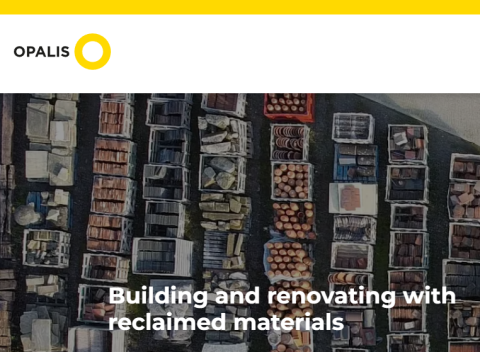
An overview of professional retailers who sell recovered building materials. These operators often offer other services as well, such as dismantling and cleaning, tailor-made components and specialised advice.
Technical documentation on the most common construction products on the reuse market.
Recent projects in which reuse materials have been applied successfully and inspiringly.
Useful documents and links for visitors who want to gather additional infomation.
The Osservatorio Innovazione Packaging is run by the Advanced Design Unit in the University of Bologna's Architecture department.Itaims to trigger innovation in the area of packaging. It collects, prepares and provides case studies, knowledge and experience in order to promote circular, collaborative and responsible innovation projects along the packaging chain.
One of the observatory's goals is to create a regional and national "network of networks" within the packaging sector so as to foster connections between stakeholders.
The platform provides planning services, bridging research, students and businesses through talent labs and competitive projects.
There are levels of access depending on the type of membership.
PACCT for Sustainability aims to make service and sustainability the keystone of businesses across Europe and to build a European community focused on Product as a Service.
With the support of ADEME, Michelin, BASF and Johnston Circular, PACCT for Sustainability strives to rethink traditional economic models so as to speed up the sustainable transformation of the economy. It will do so by developing innovative business models aiming to replace an approach based on volume and products with a service geared towards customers and impact.
The platform organises webinars exploring different aspects of the sustainable economy, from value proposition to governance and financing, and workgroups where participants can co-create solutions.
The Polyolefin Circular Economy Platform is a forum for dialogue and cooperation between all parts of the European polyolefin value chain: brand owners, retailers, waste management organisations, recyclers, converters, producers and other stakeholders. It seeks to influence policy and aims totransform the entire polyolefin system from linear to circular.
Polyolefins are an extremely valuable, widely used and versatile type of plastic, found everywhere from household settings to specialised industrial applications. They are fully recylable. They are vital materials if we want to decarbonise our society.
The platform provides data and tools to enable the polyolefin value chain to collaborate, identify barriers and develop solutions to deliver a circular polyolefin economy.
The Italian Phosphorus Platform was set up to mirror the European Sustainable Phosphorus Platform. It aims to make Italy self-sufficient in terms of phosphorus and to ensure coordination with European policies.
The Platform is made up of stakeholders active in the phosphorus chain, with an emphasis on conservation and recovery. It includes research centres, public and private institutions, businesses and environmental associations.
Phosphorus is a critical raw material for Europe: hardly any products containing it are recycled and the EU is almost entirely dependent on imports from third countries. The Platform aims to close this loop.
The Platform has four working groups: Management and coordination, Technologies and good practices, Legislation, and Market.
The Région Grand Est has five large cities (Metz, Mulhouse, Nancy, Reims and Strasbourg) and borders with Germany, Belgium, Luxembourg and Switzerland. It is the second largest industrial region in France.
Seven regional or circular-oriented organisations decided to join forces in order to set up a useful tool, promote their circular initiatives and bolster their expertise in this field. The result was plateforme collectif-grandest.org, which aims to bring all stakeholders together to develop a circular economy in Grand Est businesses.
It is a resource centre, with publications and a directory of circular businesses and initiatives. Members can join or create communities and access support when setting up a project. The platform also holds annual meetings.
The Remanufacturing platform is designed to help with the development of remanufacturing activities.
It provides resources on remanufacturing and the circular economy, includes toolkits and links to relevant publications.
Set up in 2014, Remanufacturing aims to promote remanufacturing and associated activities for product life extension. Within circular economy value recovery cycles, products can be REused, REpaired, REnovated, REmanufactured or REcycled. The aim is to reuse end-of-life products and components in new or upgraded products.
Remanufacturing has created a website describing the advantages of and barriers to starting up and developing remanufacturing activities, with examples and methodologies.