Het Hof van Cartesius is a non-governmental, bottom-up cooperative that provides circular and green workspaces for sustainable and creative entrepreneurs. The buildings are constructed completely with respect for circular design, using only secondary or biobased materials.
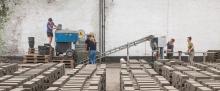
At its production site in Brussels, BC materials blends and transforms ordinary earth streams - what some consider to be waste - into perfectly circular building materials.
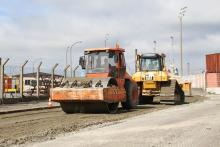
Contaminated sediment from the Port of Dunkirk has been re-used in road structures since 2002, when the Port started to cooperate with the Ecole des Mines de Douai and various industrial partners in order to design alternative materials for stabilised sub-base road layers.
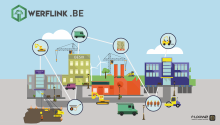
Werflink is an online sharing platform on which construction sites and companies and can share equipment, materials, resources, freight space and facilities. The platform has been set up in collaboration with the Flemish Construction Confederation, construction company BESIX, Circular Flanders and FLOOW2, to create a more circular construction sector.
Ultra Thin White Topping is a road hardening innovation, applied to pilot projects in Frysland and Overijssel by Schagen Infra BV.
To replace damaged asphalt sustainably, the company renovated the degenerated road surface using a thin layer of cement with polyester fibres mixed in. This reduced resource consumption and enabled full material recovery at end of life.
Prespaglia offers a product line of modular blocks of pressed straw for the construction sector. These insulating blocks are made of straw, clay and pozzolan lime, making them entirely recyclable and biodegradable.
SK-Tex takes old clothing and turns it into products that can be used in cars, furniture and buildings. The company has been in operation since 1998, beginning as a textile raw materials trading company before developing into a recycling company.