The Joint Initiative on Circular Economy (JICE) brings together the EU’s largest public promotional banks and institutions.
Against the backdrop of the expected EU Circular Economy Act and a shifting regulatory environment, JICE is launching a webinar series to deepen market understanding of financing needs, gaps and bottlenecks for the circular economy across selected sectors.
The Joint Initiative on Circular Economy (JICE) brings together the EU’s largest public promotional banks and institutions.
Against the backdrop of the expected EU Circular Economy Act and a shifting regulatory environment, JICE is launching a webinar series to deepen market understanding of financing needs, gaps and bottlenecks for the circular economy across selected sectors.
This webinar will focus on critical raw materials from e-waste.
The Joint Initiative on Circular Economy (JICE) brings together the EU’s largest public promotional banks and institutions.
Against the backdrop of the expected EU Circular Economy Act and a shifting regulatory environment, JICE is launching a webinar series to deepen market understanding of financing needs, gaps and bottlenecks for the circular economy across selected sectors.
The Joint Initiative on Circular Economy (JICE) brings together the EU’s largest public promotional banks and institutions.
Against the backdrop of the expected EU Circular Economy Act and a shifting regulatory environment, JICE is launching a webinar series to deepen market understanding of financing needs, gaps and bottlenecks for the circular economy across selected sectors.
Energy services provider Techem has set up a Re-Use Centre promoting a circular, resource-efficient approach to equipment management in the building sector.
Decommissioned metering devices are brought to a centralised facility, evaluated and directed towards refurbishment by manufacturers, reuse of functional devices or components, or recycling of non-reusable materials.
GO Circular is a professional training programme designed for organisations and professionals seeking to integrate circular economy principles into their business strategy.
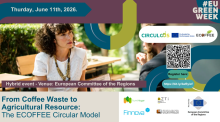
This EU Green Week Partner Event will present the innovative ECOFFEE circular model.
Discover how coffee grounds are transformed into high-value agricultural resources like natural biocides and animal feed, effectively bridging urban circularity with sustainable rural development.
Here, you can find various calls for proposals and projects for which funding is available. The calls are published in our Financing section and will be removed once the deadline has passed.
For ease of reference, we will provide a list with brief descriptions and deadlines here!
This webinar will explore what is needed to scale up the circular economy in Europe, how it can be financed, and what can be done to ensure a just transition.
This webinar will explore the challenges and opportunities facing bioeconomy stakeholders in underrepresented regions and present the support mechanisms offered by BIO-INSPIRE's cascade funding Open Call.