The circular economy is increasingly recognised as a pathway to long-term economic resilience and prosperity.
However, its application to date has focused primarily on finite, technical materials, overlooking bio-based materials. This gap limits the ability of the circular economy to deliver system-wide impact.
This paper intends to shed new light on the application of the circular economy framework to bio-based materials.
It finds that better alignment of policy agendas on circular economy and bio-based materials could deliver wide-ranging socioeconomic and environmental benefits. Many countries could see this as a key opportunity in the development of bio-based sectors within global value chains. It could also help to distribute value more fairly across all actors involved.
The European Commission is looking for input on the role and functioning of the Treaty-based Horizon Europe European Partnerships and Joint Undertakings.
Do you have experience of these initiatives and views on how they are organised? Then tell the Commission by 14 July!
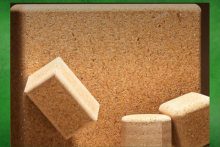
Rice Tab is a technical board developed from rice husks, an agricultural byproduct widely available in Europe.
Designed for applications in architecture, interior design and furniture, it transforms what was once considered waste into a high-performance material with a new functional life in the built environment.
This workshop will review a proposed solution to the common issues facing donors and development organisations.
See how the solution can help with duplication of activities, difficulty identifying new investment priorities and designing project proposals that target clearly identified gaps.
The European Call for Action on Circular Construction urges the EU to address key needs and potential within the construction sector as regards circularity, reuse and reduction.
At this conference, initiators and signatories along with stakeholders from the construction and demolition sector will meet with EU decision makers to hand over the Call for Action and discuss the potential of circular construction to deliver on competitiveness, climate and conservation of raw materials.
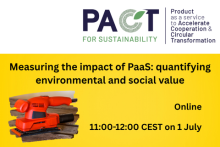
This webinar will look at how Product-as-a-Service (PaaS) models can contribute to the ecological and social transition, and more importantly, how their impact can be measured.
Waste prevention innovation in cities works, with the right conditions.
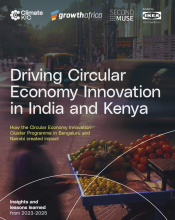
This new report reveals how two megacities built circular economy programmes that reduced waste, supported informal workers and created lasting systemic change.
It presents the lessons learned from the Circular Economy Innovation Cluster (CEIC) programme funded by the IKEA Foundation and implemented in Bengaluru, India and Nairobi, Kenya from 2023 to 2025.
The report sets out what it takes to shift urban economies away from linear, waste-making-waste-recycling models towards less waste generation in the first place.
suHCO addresses the common challenge of accelerating the sustainability transition in the healthcare sector through a Horizon Europe Pre-Commercial Procurement process.
This workshop will introduce the suHCO project and its procurement approach, and outline the planned role and benefits of the Follower Network.
What if the products around us at work could do more than just function? What if the chair you sit on, the floor beneath your feet, and the materials in your workspace could help create a healthier, more circular, feel-good environment?
Part 1 of the Day in the Life with C2C Certified® Changemakers webinar series will look at how better design and healthier materials can help create workplaces that are better for people, more practical for procurement and built for circularity.
On 28 May, CircEUlar, CIRCOMOD and CO2NSTRUCT held their joint final event.
It was pointed out that material recovery and recycling are not enough: sufficiency measures, service-focused solutions, lifetime extension, digitalisation and behavioural change will all help Europe move further and faster towards net-zero. Read about what else was discussed!