ISO 59020 covers Circular economy — Measuring and assessing circularity performance.
It provides a structured approach for organisations to measure and assess their circularity performance. It aims to standardise the process by which organisations collect and calculate data, using mandatory and optional circularity indicators.
This standard will:
help organisations align with global sustainability goals
enhance transparency and accountability in environmental reporting
support strategic decision-making for sustainable resource management.
You can read a sample or purchase the full version on the ISO website.
Together with ISO 59004 and ISO 59010, these standards offer a complete toolkit for achieving a circular economy, from principles to measurement.
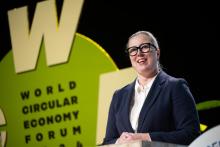
During the World Circular Economy Forum 2024, the European Commissioner for International Partnerships Jutta Urpilainen announced two initiatives intended to advance the circular economy at global level.
The establishment of the EU Circular Economy Resource Centre under the Global Gateway strategy will facilitate peer-to-peer exchanges and partnerships between EU and third-country stakeholders, fostering the uptake of sound circular economy policies and business models worldwide. The Commissioner announced a EUR 15 million commitment from the European Commission.
In addition, Commissioner Urpilainen launched the "SWITCH to Circular Economy in East and Southern Africa” programme. The European Commission will contribute EUR 40 million over five years to this programme, which will promote the transition to circular economies.
This session will present the findings of innovative demonstration projects on net zero emission and plus energy neighbourhoods around Europe, as well as the viewpoints of key stakeholders along the value chain. It will also explore the policy measures needed to finance and scale up such projects around Europe.
The main outcome will be a list of policy recommendations for private and public decision makers.
The European Commission has announced a EUR 40 million investment in the SWITCH to Circular Economy in East and Southern Africa (SWITCH-2-CE in ESA) programme.
This programme aims to advance circularity in Eastern and Southern African countries as they shift from a linear to a circular economy. It will do so by creating an enabling environment for investment in circular business models and improving access to the necessary skills and finance.
From 15 to 18 April, circular economy professionals from 168 countries came together at WCEF2024 to collaborate and turn ideas into action.
The Summary Report takes stock of the event: it presents the findings and key takeaways, including reports, tools and calls to action launched at the forum by partners, discussion highlights and key statistics.
The CEE2ACT project aims to empower Central and Eastern European countries to develop circular bioeconomy strategies. It has National Bioeconomy Hubs established in 10 countries across the EU.
It'll be holding the second webinar in its Knowledge Transfer series on 27 June.
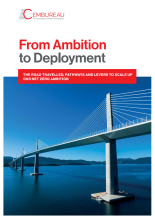
The publication of CEMBUREAU's Net Zero Roadmap is a key moment for the EU cement sector: the roadmap looks at its climate ambition, the key levers to decarbonise cement production, and the policies needed to get there.
Cement and concrete are also going circular. Circularity is an integral part of the net zero ambition, allowing for significant CO2 reduction throughout the cement and
concrete value chain. Over the past decades, the European cement industry has promoted circularity by using waste materials to make cement, both as raw materials and as fuel in its kilns.
This shift has picked up the pace over the last few years, with the adoption of new methods to develop the role played by cement and concrete in the circular economy.
The UNECE Regional Conference on the Circular Economy will take place on 26 June at the Palais des Nations in Geneva. The Conference is held under the auspices of UNECE’s regional knowledge-sharing network, Circular STEP.
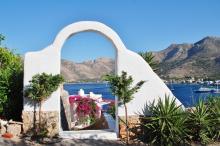
Tilos is a tiny Greek island, and in 2021 it undertook to become 'zero waste'. And it succeeded: in 2023, it was officially proclaimed a Zero Waste Certified City.
They achieved this by setting up the Just Go Zero Tilos project, in collaboration with Polygreen, a waste management company which provides solutions for industrial waste and marine pollution. The project successfuly minimised waste production and cut out landfilling.
Circe.med is a network of Mediterranean organisations involved in the transition towards ecologically and sustainable ecosystems. Established at the start of 2024, it wants to help deliver a carbon-free, circular economy which will improve people's quality of life.
The initiative aims to deepen, promote and implement a circular economy based on efficient and reduced use of natural resources.
Three main strands:
Sustainable food
Tourism and plastic in coastal areas
The built environment
The network's member organisations strive to deliver an effective circular economy in the Mediterranean which will benefit their individual ecosystems and the region as a whole.
The network is supported by an online platform, Circemed.org, which promotes cooperation and acts as a resource centre.