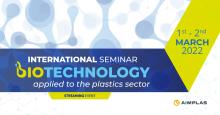
AIMPLAS organises its 1st International Seminar on Biotechnology Applied to the Plastics Sector on 1-2 March 2022, to discuss the main RDI developments and global solutions for the entire value chain. It tackles the use of organic waste to obtain new plastics, enzymatic recycling processes for plastics, the role of biotechnology in recovering complex waste, converting plastic industry scrap, etc.
On 21 January 2022 the ECESP Coordination Group 2020-2023 attended its third meeting which focussed on summarising the numerous achievements from the past year, including the recent Dubai Expo and what the ECESP had achieved there, its future plans and the 2022 programme.
Atelier Riforma started as a social economy startup with a pioneer marketplace for upcycled garments. Realising that the sorting and cataloguing of textile waste were too labour-intensive for industry standards, founders came up with the idea of developing an AI-based automated solution - called Re4circular - to create a digitized and truly efficient post-consumer clothing supply chain.
The Madeira Circular Agenda bolsters the position of the Autonomous Region of Madeira (RAM) as a circular economy hotspot.
It involves civil society and public and private entities in a system that seeks to keep materials in the economy, and to promote efficiency, circularity and sustainability as competitiveness and differentiation factors for the regional economy. The Agenda also aims to ensure that RAM companies act as circular economy leaders in their respective sectors, adopting best practices and creating innovative solutions based on circularity principles, particularly in sectors deemed critical for the region, namely agri-food, construction, tourism, social sector and the sea.
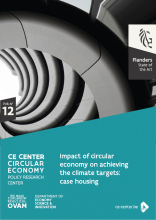
This report assesses how the circular economy contributes to reaching climate goals with regard to residential housing.
The draft Flemish climate policy plan covers the operational phase of housing and the material and carbon footprints of building and renovation. The report explores two ways to reduce these footprints: reducing the size of new housing and splitting existing buildings, and applying alternative construction methods or building materials and increasing the use of recycled and reused materials.
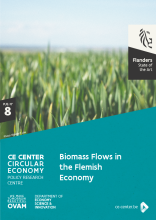
This short-term assignment attempts to improve our understanding of the data availability of biomass flows within the Flemish economy and develops a methodology to approximate the flow of biomass between different industries.
This needs to be done in order to maximise their potential and reduce unnecessary waste flows. However, the report finds that the data currently available are insufficient, and considers that the construction of a physical counterpart to monetary input/output tables might be the answer.
Within the framework of the Circular Economy Initiative Deutschland (CEID) and its three interdisciplinary and cross-sectoral working groups, more than 130 experts from industry, science and civil society have summed up their findings in the Circular Economy (CE) Roadmap for Germany, which consists of a consolidated opinion addressing society as a whole.
This Roadmap, which has focused - right from the beginning - on shaping a consistent and common target vision for a circular economy in 2030, is a scientifically-based framework for action that systemically describes the necessary steps for Germany to transition to a CE and provides decision-makers from politics, industry and science with concrete recommendations for action.