The Madeira Circular Agenda bolsters the position of the Autonomous Region of Madeira (RAM) as a circular economy hotspot.
It involves civil society and public and private entities in a system that seeks to keep materials in the economy, and to promote efficiency, circularity and sustainability as competitiveness and differentiation factors for the regional economy. The Agenda also aims to ensure that RAM companies act as circular economy leaders in their respective sectors, adopting best practices and creating innovative solutions based on circularity principles, particularly in sectors deemed critical for the region, namely agri-food, construction, tourism, social sector and the sea.
This report assesses how the circular economy contributes to reaching climate goals with regard to residential housing.
The draft Flemish climate policy plan covers the operational phase of housing and the material and carbon footprints of building and renovation. The report explores two ways to reduce these footprints: reducing the size of new housing and splitting existing buildings, and applying alternative construction methods or building materials and increasing the use of recycled and reused materials.
This short-term assignment attempts to improve our understanding of the data availability of biomass flows within the Flemish economy and develops a methodology to approximate the flow of biomass between different industries.
This needs to be done in order to maximise their potential and reduce unnecessary waste flows. However, the report finds that the data currently available are insufficient, and considers that the construction of a physical counterpart to monetary input/output tables might be the answer.
Within the framework of the Circular Economy Initiative Deutschland (CEID) and its three interdisciplinary and cross-sectoral working groups, more than 130 experts from industry, science and civil society have summed up their findings in the Circular Economy (CE) Roadmap for Germany, which consists of a consolidated opinion addressing society as a whole.
This Roadmap, which has focused - right from the beginning - on shaping a consistent and common target vision for a circular economy in 2030, is a scientifically-based framework for action that systemically describes the necessary steps for Germany to transition to a CE and provides decision-makers from politics, industry and science with concrete recommendations for action.
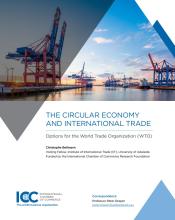
This study highlights that, while international trade has a vital role to play, policy responses to-date have largely been designed at the national level and in an uncoordinated manner.
ICC Secretary General John W.H. Denton says that "the report shines a light on how well-intentioned national policies are inadvertently hindering the adoption of circular solutions in the real-economy. Simply put: the transition to a circular economy can only be enabled at scale by harnessing the power of cross-border trade to unlock economies of scale and comparative advantages. We hope our analysis will serve as a clarion call for a concerted global effort under the auspices of the World Trade Organization to enable new patterns of trade capable of meeting global climate and sustainability goals".
In Limbo is a platform (digital website and physical warehouse) facilitating the reuse of materials within thesocial and cultural sectors and schools in Brussels.
It encourages exchange and mutual aid within these sectors, as well as boosting recycling, reducing landfill costs and enabling organisations with limited resources to obtain reusable materials. Following the principles of circularity and sharing, all partners are invited to give and receive materials for free.
In Limbo is open only to registered partners which must be formal or informal non-profit associations or collectives, specifically social, cultural and artistic organisations, schools and temporary projects in Brussels. However, In Limbo accepts donations from all types of organisations.
In 2020 the EU’s circular material use rate reached 12,8 %, i.e. almost 13 % of material resources used in the EU came from recycled waste materials, according to Eurostat.
The circularity rate - which is part of the EU monitoring framework on the circular economy - is the share of material resources used coming from recycled waste materials, thus saving extractions of primary raw materials.
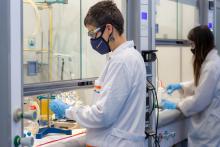
The EROS Project, with the participation of AIMPLAS and ITC, is working to develop new recycling processes to recover composite materials from the aeronautics and wind turbine sectors to manufacture new products for the transport and ceramics industries.
Join this year's Nordic Circular Summit exploring the circular economy in the Nordic region on 23–26 November, and learn about the region’s tremendous circular opportunities.