The Re-Shoes LIFE project wants to provide an alternative, circular and sustainable solution for footwear end-of-life management. The European Platform for Sport Innovation (EPSI) will organize the Re-Shoes project launch event on 6 June 2023 in the Azores (Portugal), as part of the EPSI Annual Conference 2023.
EDANA, the leading global association and voice of the nonwovens and related industries is launching its first Sustainability Forum, which is an evolution of their previous Circular Nonwovens Forum. It will cover all relevant sustainability topics for the nonwoven industry: natural raw materials, consumer expectations, circularity, bio-economy, etc.
The Directorate General for Internal Market, Industry, Entrepreneurship and SMEs (DG GROW) of the European Commission has launched work on a study regarding “Background Data Collection for Future EU End-of-Waste Criteria of Construction and Demolition Waste”.
In this context, the Commission is opening an online stakeholder survey, available until 31 August 2023.
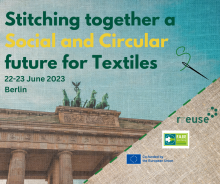
This event, organised by RREUSE on 22 and 23 June with the support of FairWertung, will bring together leading experts, social entrepreneurs, policymakers, and social enterprise leaders to discuss the current state of the textiles market and explore innovative ways to increase re-use and reduce textile waste.
Kosovo, a potential EU candidate country, has embarked on an ambitious journey – the transition towards a circular economy. The aim of this journey is:
to preserve the country’s nature and rich biodiversity
to valorise its resources and talent,
to contribute to a more resilient and regenerative economy and a society where everyone has the opportunity to live a good life.
This roadmap by Kosovo's Ministry of Environment, Spatial Planning and Infrastructure identifies six priority areas: a) food and b) forestry systems, c) creative and d) retail sectors, e) built environment and the f) manufacturing sector.
Given the strong interdependency of these sectors, the Roadmap also introduces horizontal areas that enable and support priority areas and further promote circular transition.
On 23 May, the AL-INVEST Verde Programme, funded by the European Commission for promoting sustainable growth and job creation in Latin America, launched its second call for proposals. Join the information session and discover more about the programme and the call terms and requirements.
Two online information workshops (on 5 and 13 June) will be organised for associations, chambers of commerce and other institutions representing the private sector, research centres and think tanks. During the workshop, an overview of the programme as well as full information on the second call will be presented.
This online session on 2 June 2023, from 10:00 to 12:00 (GMT+2), explores how cities worldwide can unlock the potential of the circular economy at the local level, while promoting biodiversity and nature conservation.
Join this session on 25 May 2023 from 10:30 to 11:30 CEST to catch up with the DEFINITE-CCRI project and the Project Development Assistance services offered to cities and project owners to develop bankable circular economy projects and secure financing.
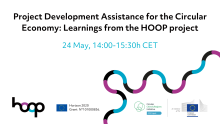
On 24 May, the HOOP project will share insights from the delivery of Project Development Assistance to eight cities and regions aiming to increase the circularity of biowaste.
Four-day long celebration of the circular economy in Dublin running from 29 May to 1 June 2023. A unique gathering of international experts, industry leaders and forward-thinking individuals, dedicated to advancing the circular economy agenda.