RCA Engineering has come up with modular plants for recycling composite materials. The modular engineering and construction process produces plants that can be assembled quickly and affordably.

MAZOVIA CIRCULAR CONGRESS 2023 is one of the biggest and most prestigious conferences in Europe regarding the circular economy. Mazovia Circular Congress is the focal point of the Circular Week initiative, an international educational campaign about the circular economy and sustainable production and consumption.

This year, the organisers would like to contribute to and accelerate the transformation into a circular future. The event is geared towards public administration, local municipalities, companies, corporate social responsibility officers, sustainable managers, local administration, start-ups and media. It is being promoted broadly and so will also reach the general public.

The main objective is to educate people about the circular economy and sustainable development and promote sustainable businesses and solutions. The organisers would like to show what could be achieved by closing the loop and how sustainable consumption and production can have a positive impact on the environment, biodiversity loss and climate change. Through Circular Week, they would also like to promote effective and innovative green solutions and effective systemic changes. The event focuses on raising awareness and triggering behavioural change and engagement in the circular transition.


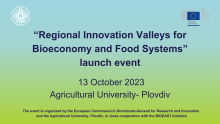
This launch event on Regional Innovation Valleys for Bioeconomy and Food Systems will take place on 13 October 2023. It is organised jointly by the European Commission's Directorate-General for Research and Innovation and the Agricultural University of Plovdiv, in close cooperation with the BIOEAST Initiative. It will be webstreamed and recorded.

Upload document

China's Circular Economy Transition: Challenges and Solutions Ahead

China with water
Author
Ru Chen
Publication Date
02/2023
Country
Denmark
Language for original content
Scope

This white paper examines China's transition to a circular economy.

A new plan for China’s circular economy (CE) was set out in the 14th Five-Year Plan 2021-2025. Circular Innovation Lab's previous paper on China’s Circular Economy Policies: Review and Reflection argued that there has been significant improvement in environmental aspects in China. It also identified challenges in the implementation of past five-year plans, such as coordination challenges, uneven and unsustainable development, and lack of research.

This paper builds on those findings to address the way forward in China's CE transition, including challenges and opportunities.

Upload document

The Role of SMEs in China's Circular Economy Transition

More than 140 million SMEs make up a significant part of China's economy and technological innovation.

However, they are also responsible for significant environmental issues, with most environmental regulation violations in China being incurred by SMEs. This paper investigates how SMEs can help China transition to a circular economy by harnessing their potential for technology innovation and flexibility in adopting circular practices. By looking into the development characteristics of Chinese SMEs, it highlights the implications for SME-related policies and management and emphasises the need for collaboration between businesses, NGOs and individuals.

By tapping into their strengths, SMEs can play a vital role in delivering the successful transition to a circular economy in China.

Subscribe to