Upload document

China’s Circular Economy Policies: Review and Reflection

China’s Circular Economy Policies
Author
Ru Chen
Publication Date
01/2023
Country
Denmark
Language for original content

The circular economy was introduced in China’s policies in 2002 and has evolved into a national strategy and a fundamental pillar of the economy. However, while the efforts so far are worth celebrating, issues such as coordination challenges, uneven development, unsustainable success, and a lack of research are still undermining China's circular development.

This paper builds a primary framework by reviewing the development of China's circular economy policy. The paper consists of a policy review, the implementation and the corresponding outcome, challenge identification, framework establishment and application.

Upload document

A Critical European Raw Materials Management System: The 2023 Playbook

A Critical European Raw Materials Management System: The 2023 Playbook
Author
Philippa Noble
Publication Date
06/2023
Country
Denmark
Language for original content
Scope

This paper - part of the A Circular Economy Vision series - follows one of Circular Innovation Lab's previous analyses of the potential effects of the European Critical Raw Materials Regulation (ECRMR) on developing economies.

It focuses on the EU’s domestic critical raw material (CRM) markets, revealing how the current hyperfocus of the policy on extraction, processing and recycling is not applicable to all identified CRMs. By analysing the limits of the ECRMR as it stands, the paper argues that a supporting structure of circular economy legislation could promote a successful ECRMR for all CRMs, not just those that could benefit from recycling infrastructure.

The paper provides detailed policy recommendations for each CRM where data allow.

Upload document

Impacts and Opportunities for Developing Economies under the European Critical Raw Materials Regulation

As the world transitions to green energy and greater technology use, critical raw materials (CRMs) are the new frontier of economic and political disputes.

The EU has recognised this threat to supply chains, passing the European Critical Raw Materials Regulation to help stabilise EU access to CRMs. Published in March 2023, the regulation seeks to improve EU extraction, processing and recycling capacity with minimal reliance on other states. However, the EU has limited sources of many CRMs, and so strategic projects in third countries will be utilised to ensure that EU demand is met.

This paper discusses the possible impact of this regulation on developing economies, exploring how they will be affected by strategic projects, shifting EU import demand, and circularity incentives.


The European Commission has launched three calls for input: on eco-design requirements and labelling of electronic displays, on the WEEE Directive and on the new end-of-life vehicle rules.

Do you feel strongly about any of these issues? Then tell the Commission!

The Pop-Machina project consortium is thrilled to invite policy stakeholders and decision-makers to participate on 14 September 2023 in its upcoming International Policy Roundtable focusing on the policy recommendations and lessons learnt during the project on circular economy, the maker movement as well as their convergence.

Ambition4Circularity is a platform collecting circular commitments by large French companies. It is supported by the French Association of Large Companies (AFEP) that reflects their growing commitment to move towards a more sustainable production model.

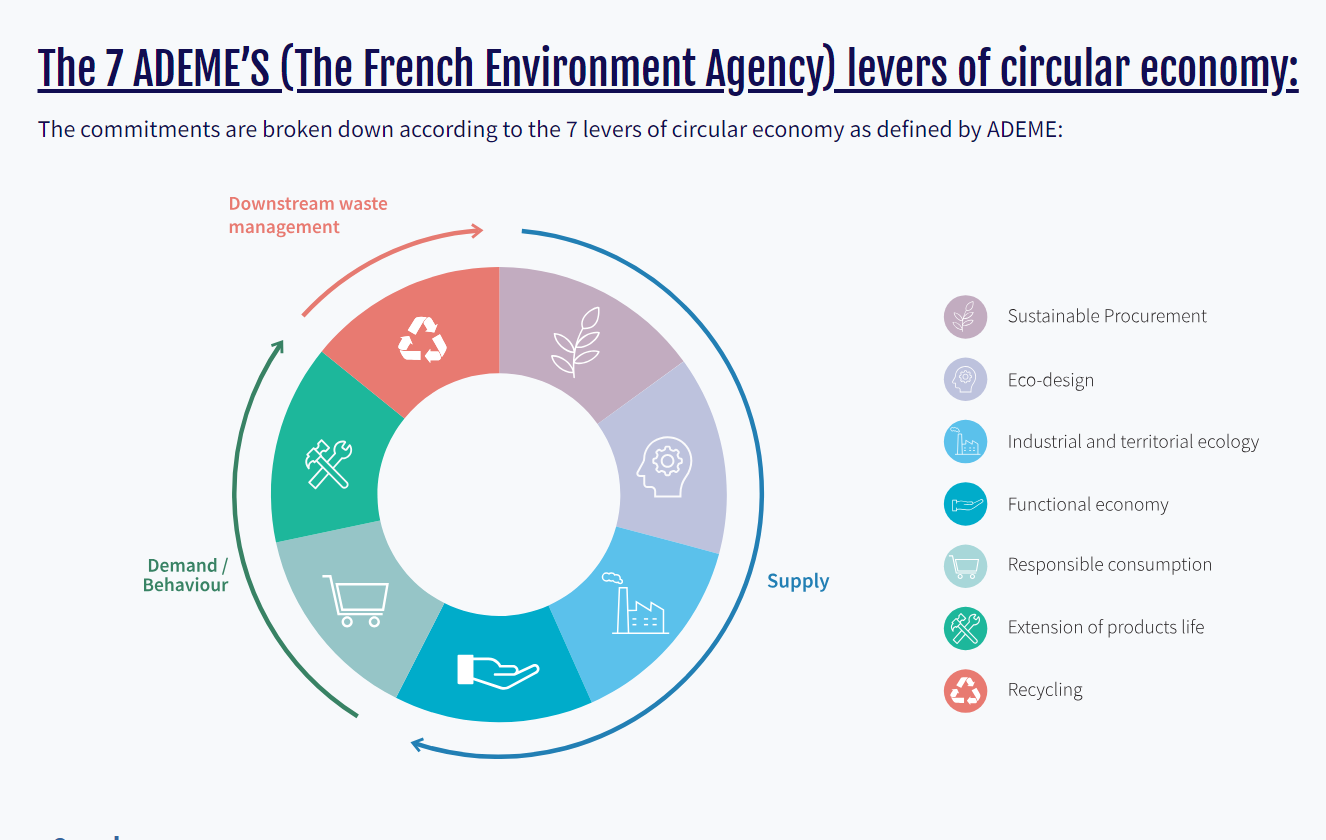
Companies have been mobilising since 2017, with a wide range of commitments to activate the seven pillars of circular economy as defined by the French Agency for Ecological Transition (ADEME) and based on their specific activities.

The commitments listed on the platform primarily involve the company’s internal stakeholders, along with suppliers, partners and customers. All aspects of the circular economy are leveraged in these commitments, from the supply of sustainable resources to the repair and recycling of the end product.

7 levers of circular economy

Sitra, the organiser of the World Circular Economy Forum (WCEF) 2024, is opening a call for the leading European companies working on circular solutions for nature. Is your company involved in fighting against biodiversity loss using circular economy principles?

WCEF is compiling a list of companies to be featured at next year’s WCEF. Apply by 30 September to be included in the new list!

Selling or buying reconditioned items? Learn what the process involves in France!

To be recognised as reconditioned in France, an item has to follow a series of compulsory steps.

Sellers must be fully transparent about the source(s) of the product they are selling, reconditioning must take place on the premises where the product is sold or very close by. The product warranty must  be extended to two years. Reconditioners should preferably use green transport and must be aware of their Extended Producer Responsibility and provide recycling bins for batteries, electrical appliances, etc. The original packaging should be preferably be used for packing the reconditioned goods.

These are just some of the rules that must be abided by in order to sell reconditioned items in France. 

Delivering a just and successful circular economy transition requires engaging a multitude of stakeholders at the nexus of several areas of expertise, including digitalisation, agriculture, business management, governance and policy, innovation and finance.

This autumn, on 18 and 19 October, UNECE, in collaboration with the Ministry of Environmental Protection of the Republic of Serbia, will organise the first in-person Regional Policy Dialogue under the Stakeholder Engagement Platform - Circular STEP.

The BioICEP project aims to develop sustainable and environmentally friendly alternatives to traditional petroleum-based plastics.

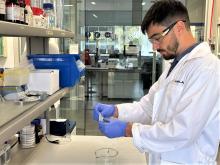
The project has used an innovative cascade process by applying and combining chemical and biological methods to turn fossil-based plastic waste into natural, biodegradable substitutes to be used in the packaging and pharma industries.
 

Subscribe to