Gravity Wave is a social start-up based in Spain. It focuses on working with small-scale fishermen to collect as much as possible of the plastic waste fouling the Mediterranean, from water bottles to a whole load of discarded fishing nets.

Knof is a Slovenian social enterprise with a focus on circularity and sustainability. It operates reuse boutiques, a circular laboratory and a programme for individuals and entrepreneurs supporting sustainable companies.

Anako
Type of organisation or company
Country
Italy
Language for original content
Key Area
Scope

Parma Municipality, the Confederazione Nazionale dell’Artigianato e della Piccola e Media Impresa (National Confederation of Crafts and SMEs) and La coperta di Linus have launched a project called Arteinborsa (A-Bag-from-Art). This project uses old posters from local exhibitions to create bags and accessories.

Do you know any outstanding organisations dedicated to awareness raising and citizen engagement on the circular economy? As CE experts and members of the circular community, you are invited to share links and insights into these Centres of Excellence via a survey which is being carried out by the Citizens Engagement and Behaviour Change Leadership Group.

The MixMatters project aims to optimise the value derived from mixed biological waste. It will introduce a groundbreaking, integrated and adaptable solution for efficiently harnessing the potential of mixed bio-waste.

Procura+, Lisbon
Event type
City
Lisbon
Country
Portugal

ICLEI Europe and the City of Lisbon (Portugal) are proud to announce that the 11th Procura+ Conference will be held in the Portuguese capital on 13 and 14 March 2024.

The conference will showcase how cities and public authorities can use public procurement to implement step changes that make a big impact.

Illustration with the event title on the left and people completing a puzzle on the right.
Event type
City
EU
Country
EU
Key Area
Scope

People are ultimately the drivers behind environmental change. They are the ones who will help organisations make the necessary changes to implement an efficient environmental management system, reduce the organisation's environmental impact and become more circular as a business and, in general, as a society.

Since its inception, the EU Eco-Management and Audit Scheme (EMAS) has sought to be a tool to help companies reduce their environmental impact and gain acceptance in their area by being transparent about their environmental performance and maintaining an open dialogue with stakeholders.

But how can you involve staff in environmental management? How are the EMAS tools helping to involve staff and top management in reducing environmental impacts and enhancing resource efficiency? What good practices has EMAS identified for involving employees and stakeholders in its 30 years of experience? Do people recognise the importance of their day-to-day behaviour in achieving environmental improvements at work and at home?

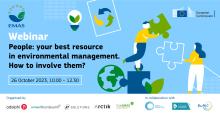
To answer these questions and have an interesting discussion with the audience, EMAS and ECESP organised a webinar on 26 October, to learn more about EMAS and the importance of involving staff, top management and stakeholders in the circular transition.

Subscribe to