Photo of Paolo Campanella
Type of organisation or company
Country
Belgium
About this contact

FEAD represents the private waste and resource management industry across Europe. Its members, national waste management associations and companies, operate across the entire value chain, including collection, sorting, recycling, recovery and disposal. FEAD brings together around 3 000 private waste management companies, which operate in 60% of Europe’s municipal waste markets and 75% of industrial and commercial waste, supporting over 500 000 local jobs. FEAD’s vision is to shift Europe's overall material use towards recycled materials, promoting sustainable waste management as a cornerstone of the circular economy, contributing to environmental protection, resource efficiency and climate goals.

Paolo Campanella is Secretary-General of FEAD, leading the organisation’s advocacy for a stronger and more coherent European legislative framework to support the circular economy. With over ten years of experience across multiple areas of the waste sector, including plant design, operational management, consultancy and public affairs, he brings a comprehensive understanding of the industry's challenges and opportunities. Trained as an environmental engineer, he has managed the design and permitting of waste treatment facilities and assessed project proposals within the public administration of the Province of Bari (Italy). He previously served as a board member of the Italian Association of Environmental Engineers. 

Photo of Nicolas Garnier
Type of organisation or company
Country
Spain
About this contact

Interact represents all programmes run by Interreg, the EU’s instrument for territorial cooperation, helping regions and communities work together across borders on shared challenges. Through its Smarter and Greener Europe networks, Interact connects programmes and projects advancing the circular economy, from resource efficiency and waste reduction to digital and innovation-driven circular solutions. It facilitates learning, exchange and policy linkages, ensuring that results from cooperation shape regional and EU transitions alike. By linking circular innovation with territorial development, Interact showcases how collaboration across borders delivers both smarter systems and greener outcomes, turning Europe’s circular ambitions into practical, place-based action.

Nicolas Garnier is Thematic Capitalisation Manager at Interact, leading the Greener Europe policy network and supporting Interreg programmes as they step up their impact on sustainability, climate and the circular economy. He facilitates cooperation and knowledge exchange amongst regions and EU actors, helping translate project results into policy learning and strategic action. With experience in environmental governance, innovation and regional cooperation, Nicolas drives capitalisation efforts that connect circular solutions across Europe, from local experimentation to EU-wide policy dialogue. His work focuses on making cooperation a catalyst for a greener, more resilient and circular Europe.

Photo of Jean Billant
Type of organisation or company
Country
France
About this contact

Circul’R was established in 2017 and is now a leading voice on the circular economy in France and internationally thanks to the close links it has established with all stakeholders: large companies, VSEs/SMEs, producer responsibility organisations (PROs), public institutions and local governments. Circul’R is firmly committed to supporting organisations - whether public or private - in their transition to circular models and modes of operation.

To achieve this mission, Circul’R works at three levels: 
1. Training - Raising awareness of the circular economy among managers and employees and enhancing their skills in this area.
2. Leading coalitions - Creating and leading coalitions of committed players to set new standards in circularity.
3. Consulting - Support private and public organisations in setting up circular economy projects, from roadmap to operations.

Circul'R has a team of 40 circular economy experts.

With over 10 years of experience in sustainability and the circular economy, Jean has worked across NGOs, public institutions and consulting. He started at the NGO GERES, supporting access to energy  projects, then joined ReLondon to coordinate circular economy initiatives for the Municipality of London, including the “London’s Food Footprint” study. At Circul’R, he now leads projects with private companies and public authorities in France and internationally, supporting the design and implementation of circular strategies. He actively facilitates dialogue between sectors to overcome barriers to circularity, notably through coalitions and collaborative projects. As part of the ECESP Coordination Group, he aims to foster cross-sectoral cooperation and share field insights to advance Europe’s circular transition.

Photo of Claire Downey
Type of organisation or company
Country
Ireland
About this contact

The Rediscovery Centre is Ireland's national centre for the circular economy. Since 2004, the centre has been leading Ireland’s transition to a circular economy and low-carbon, sustainable future. Based in Europe’s first circular economy demonstration centre, the Rediscovery Centre acts as an innovation hub, delivering education, providing research and enabling policy, citizen engagement and collaboration to support community action. Recognising that a just transition requires a social movement, they use their skills and expertise to ensure that all people benefit from, and can participate in, the circular economy. Their work is supported by key strategic partners and includes a range of public engagement, education and research programmes, workshops and training courses across broad disciplines.

Appointed Chief Executive of the Rediscovery Centre in February, Claire brings over 20 years' experience in the sector to this role and is a dedicated advocate for circular living. Claire actively contributes to national and international policy development, groundbreaking circular economy research and education initiatives in Ireland and beyond, and is a fellow of the Chartered Institute of Waste Management.

The EU Ecolabel is the official European Union voluntary label for environmental excellence. See why it's good for the circular economy (and consumers!), have a look at the latest figures and watch the video on why public procurers should choose EU Ecolabel certified products.

The European Commission has launched a call for evidence on advanced materials, which will feed into the Advanced Materials Act. See what it's about and give your views! 

Open from 21 October 2025 to 13 January 2026.

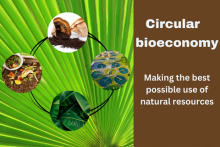
"Circular bioeconomy – making the best possible use of natural resources. Focus: Biodegradable packaging from mycelium and agricultural waste". Images of coffee grounds, food waste, banana leaves and sewage ponds.
News type
Country
Netherlands
Key Area

The ECESP website has a good selection of circular bioeconomy-themed content. We'll be shining a spotlight on some of it here!

This item looks at biodegradable packaging from mycelium and agricultural waste.

Photo of Kari Herlevi
Type of organisation or company
Country
Finland
About this contact

Sitra – The Finnish Innovation Fund is a pioneer in advancing the circular economy globally. As the initiator of the world’s first national circular economy road map, Sitra addresses societal challenges that shape our world. Their international programmes collaborate with partners to solve global challenges, enhance well-being and boost economic growth within the Earth’s carrying capacity. They drive systemic change through research, innovation and stakeholder collaboration. Promoting circular business models, skills, jobs and policies, they actively contribute to EU-level initiatives such as the European Circular Economy Stakeholder Platform (ECESP). Globally, Sitra advances circularity through the EU Circular Economy Resource Centre (EU CERC) and the World Circular Economy Forum (WCEF), a leading annual conference and global platform for knowledge exchange and partnership building, initiated by Sitra.

Kari Herlevi is Programme Director for Global Circular Economy at Sitra. He leads Sitra's international efforts to advance the circular economy, focusing on systemic change, foresight and cross-sectoral partnerships. Kari has played a key role in shaping global circular economy dialogues, including the WCEF and the EU CERC. With a background in sustainability and innovation policy, he works to align well-being and economic growth with planetary boundaries. Kari is a frequent speaker at international events and a driving force behind Sitra’s global initiatives to promote regenerative and inclusive circular solutions.

About this contact

Academics for Circular Economy (ACE) is an international non-profit network connecting PhD researchers, postdocs and early-career academics working on circular economy topics. ACE strengthens research capacity through peer learning, mentoring and skills development in research design, stakeholder engagement and science communication. Their mission is to bridge the gap between academic research and practical action by connecting researchers with policymakers, industry and civil society actors. Through collaborative projects, workshops and policy dialogues, ACE fosters high-quality, interdisciplinary research that advances circular economy implementation and systemic sustainability transitions globally.

After over a decade in industry, Priya Saikumar has transitioned to academia to complete her PhD on Circular Economy Transitions in the Electrical and Electronic Equipment sector at the University of Oxford. Priya and seven other members met through an online Circular Economy PhD peer community, and recognised that research and practice in the field often remain siloed. As a result, valuable, high-quality doctoral insights are overlooked and reinvented for decision making in policy and industry. To address this, they founded Academics for Circular Economy, a non-profit that bridges academia and practice by making rigorous research accessible to practitioners while also enabling PhD scholars to apply their expertise and break free of the publish-or-perish cycle.

Photo of Arianna Crosera
Type of organisation or company
Country
EU
About this contact

Generation Climate Europe (GCE) is the largest coalition of youth-led networks at European level on climate and environmental issues. Uniting the largest youth-led networks in Europe, they bring together 381 national organisations across 46 countries in Europe.

Arianna Crosera is Coordinator of the Circular Economy Working Group at GCE. She has a background in European and international law. In GCE, she has worked to advocate for a more circular economy with a focus on intergenerational justice, in particular in relation to the digital economy. She has represented GCE in high-level venues such as the EU Industrial Forum, EU Raw Materials Week, the ECESP and the International Energy Agency's 8th Annual Global Conference on Energy Efficiency. Across these roles, she has worked to ensure that youth voices shape the environmental and energy transition at every step of the legislative process. She is currently a Ph.D. researcher in Law at the European University Institute. As an academic in EU environmental and energy law, she regularly contributes to international conferences with her work on regulating the environmental impact of the data-centre industry. 

Subscribe to