Although previous researchers have explored the circular economy practices of different businesses in various contexts, only a few papers have focused on the sustainable preparation and consumption of food in the tourism and hospitality industry. This paper sheds light on case studies from hotels, restaurants and cafés that are located in urban tourism destinations.
This research suggests that catering businesses can implement a number of responsible initiatives by introducing preventive measures and recycling practices to curb food loss and the generation of waste. In conclusion, it finds that there is scope for regulatory authorities and policy makers to encourage hospitality practitioners to minimise food waste.
Cities and local areas play a major role regionally in promoting the launch and implementation of systemic changes needed for the transition towards a circular economy. The ECESP Leadership Group on Cities and Regions focuses on this approach. In 2021, three meetings and two EU Circular Talks (EUCT) were organised.
Yuman Village is a temple of the circular economy located in Brussels. It offers a unique 'one stop shopping' experience that encourages the emergence of new circular economy models, creates local jobs and reduces the number of trips needed to buy sustainable and local products.
The authors of the study apply ascendency analysis (a systematic method based on information theory for quantifying the efficiency and resilience of natural ecosystems) at EU level and discuss the implications for urban waste management systems, taking the Netherlands as an example.
They argue that ecological principles can be useful for developing human-made systems. The system is made sufficiently robust to be able to cope with shocks by including a diverse set of stakeholders who provide:
resource-use efficiency through specialised know-how in capturing, processing and delivering a range of resources, and
resilience by generating multiple paths that allow these vital resources to circulate throughout the urban network at different levels and rates.
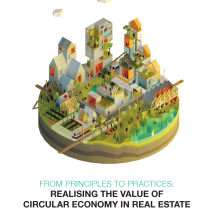
Arup has joined forces with the Ellen MacArthur Foundation to produce a report on the value of circular economyin real estate.
The circular economy offers real estate investors a framework for achieving environmental and social goals while delivering better economic performance. How do real estate business models need to change - apart from eco-design - if circular principles are to scale up in this sector?
The report defines five models to improve financial performance to the benefit of real estate investors and construction clients: