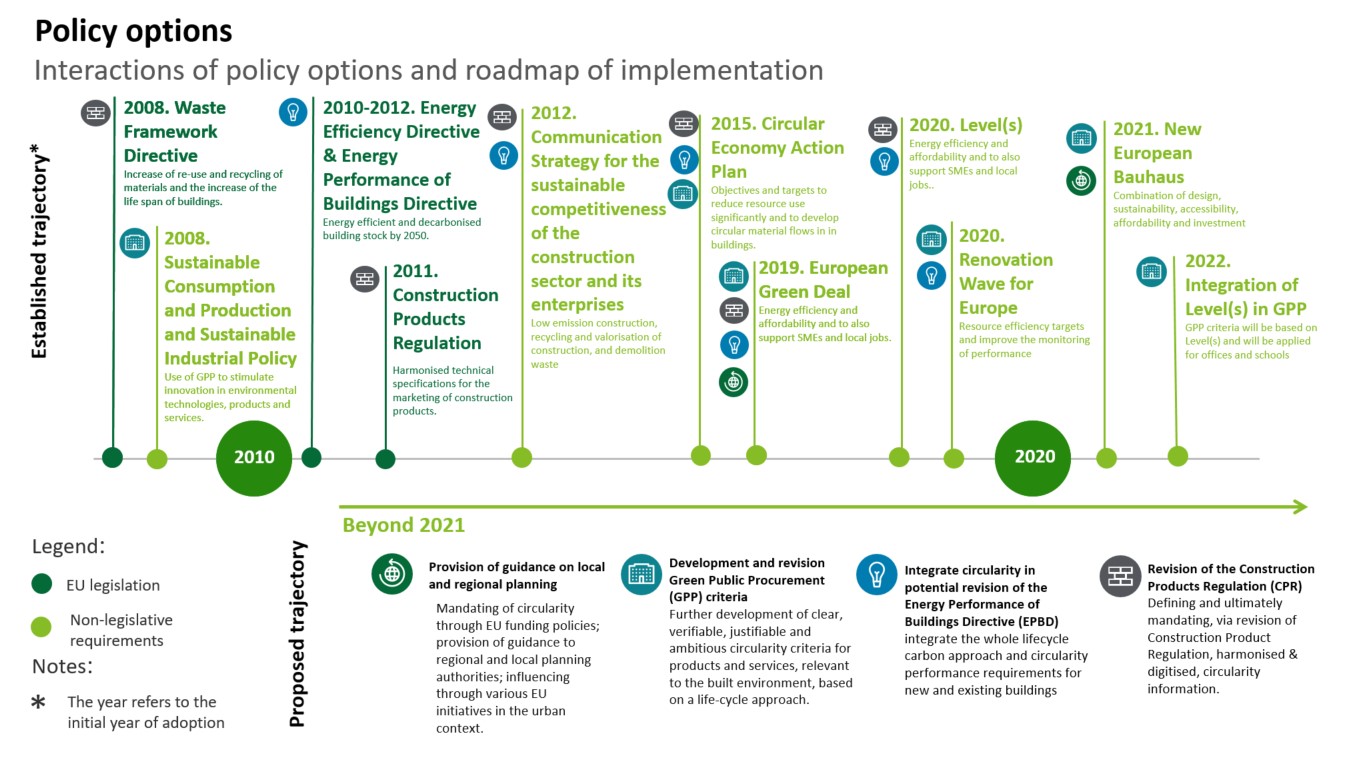
This study aims to assist the European Commission to identify policy options that support the uptake of circular economy principles for buildings’ design in European, national and local policies.
The goal is:
to increase the service life of buildings
to facilitate the use of secondary materials and
to improve resource efficiency across the building life cycle.
The study also provides key insights and recommendations on actions for a roadmap supporting the uptake and implementation of circular economy principles for buildings’ design.
The brochure Circular Cities shares knowledge and experience of circular solutions from the Netherlands to inform and inspire people and to stimulate international cooperation.
Ristorazione Sostenibile 360° is the first voluntary certification programme for regional catering, suitable for any type of restaurant in the Emilia-Romagna Region (IT).
In Italy and France, where the IN.TE.SE project was developed, new decentralised composting services were designed and implemented for domestic and community users, tailored to the local areas.
Textiles are an important issue for cities, as people generate more and more textile waste. City authorities are required to provide for separate collection of used textiles but have limited ways of putting the waste generated to good use.
Eurocities’ paper on circular textiles is published ahead of the Commission's new Strategy for Sustainable Textiles, planned for autumn 2021, to help the EU shift to a climate-neutral, circular economy (CE) where products are designed to be more durable, reusable, repairable, recyclable and energy-efficient. It focuses on a sustainable recovery of the textile sector from the Covid-19 crisis by:
making it more competitive,
applying CE principles to production, waste management, etc.
and directing investment, research and innovation.
The EU's Bioregio project covered a range of initiatives, all of which are described in its website: from a waste management system in Jelšovce Distillery in Slovakia to biogas units for household applications in Romania and a Spanish project combining the fight against food waste and social inequality.
The COVID-19 may have hit the pause button on tourism, but it also highlighted the need to switch to the circular economy.
This report summarises the findings of a two-year policy dialogue with the city of Granada in Spain, and provides recommendations and a vision to transition to a circular economy. It draws on Granada’s own experience with the transformation of a wastewater treatment plant into a bio factory in 2015, which contributed to increased water reuse and the production of new material from waste. The report argues that the city of Granada can play a role as a promoter, facilitator and enabler of the circular economy. This will require a collective and coordinated approach across all stakeholders and levels of government.