In March Ecopreneur.eu published the preliminary results of a study on the potential impacts of an EU circular fashion industry on non-EU textile producing countries.
The French "Institut National de l'Economie Circulaire" (INEC) and Orée have published a co-authored study to better understand circular economy initiatives dynamics at work in different countries.
This factsheet on Metal Recycling developed by EuRIC highlights the importance of both ferrous and non-ferrous metal recycling and their substantial benefits for the environment and the economy in Europe.
The Brochure outlines the environmental benefits, the economic and international trade aspects of steel, aluminium and copper recycling.
Une centaine d’acteurs (décideurs, entreprises, collectivités, associations etc.) se sont réunis le lundi 27 janvier 2020 pour la conférence de l’Institut National de l’Économie Circulaire Loi anti-gaspillage pour une économie circulaire: quels changements pour les entreprises?
Member of the ECESP Coordination Group Circular Change provides an overview of its activities in 2019. Circular Change is led by Ladeja Godina Košir - chair of the ECESP Coordination Group.
Through the use of circulytics, a company is able to use various circularity indicators in order to assess how well a product or company is performing in the circular economy.
The ECESP Coordination Group met for the third time on 17 October 2019 in Brussels to review the Platform's 2019 activities and define its objectives for 2020.
Destination Climate Neutrality brings together leading recommendations of think tanks, scientists, thought leaders and NGOs to offer a policy blueprint for how best to propel Europe towards net zero carbon emissions in the coming 5 years of the Von der Leyen term. It offers sector-by-sector analysis, targets and initiatives in governance, finance, industry, energy, transport, the circular economy, agriculture and employment.
On circular economy, the report sees challenges in:
a lack of EU targets for waste prevention, reuse, repair and refurbishment
no monitoring framework for material flows
contamination of materials by hazardous ingredients
high demand for biomass.
The authors identify opportunities in job creation, cleaner supply chains and product policies.
Public authorities will soon be encouraged to apply the Lifecycle Assessment (LCA) approach to their policies thanks to a new Interreg Europe project, LCA4Regions. The 9 project partners met for the first time in Brussels, on 30 September and 1 October 2019, the with support of ACR+.
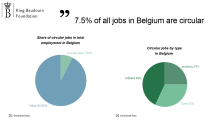
This report presents a baseline measurement of employment in the Belgian circular economy and provides insights into the nature and number of jobs in the country’s circular economy. This includes all jobs contributing to the circular economy through activities in renewable energy, repair and maintenance, recycling, digital technology, design, new business models and collaboration.
This report, conducted by the King Baudouin Foundation and the Dutch social enterprise Circle Economy, aims to inform governments, employers, social partners and other representatives with a view to pursuing effective and inclusive circular labour policy.