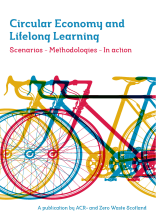
The Circular Economy Competences, Making the Case for Lifelong Learning report, published by ACR+ and Zero Waste Scotland , builds on the workshop these orgnisations hosted in the Euroepan Parliament on 19 February 2019. It gathers the experiences participants shared in that workshop, and is meant to help educators, policymakers and managers of NGOs involved in training and educational organisations to promote the development of local circular economy loops.
The three chapters of this booklet cover different areas of the lifelong learning landscape:
Circular thinking in education
Upskilling waste, repair & reuse industry
Facilitating the transition towards a circular economy.
ACR+ has consistently advocated to accelerate the circular economy, while also showcasing urban best practice in circular economy throughout 2019 at various events across the European continent.
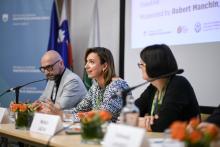
At the 14thBled Strategic Forum, Ladeja Godina Kosir, Chair of the ECESP Coordination Group, will be moderating panels on sustainability policy and circular economy.
The CSCP, Sitra and DBU have set up the Consumer Insight Action Panel, a new European multi-stakeholder initiative designed to support the transition to the circular economy by generating, applying and testing consumer behavioural insights in circular strategies for textiles, plastics and electronics. How might we innovate to enable people to reuse, repair, share or recycle? Find out with us!
Businesses across Europe are fully engaged to maximise the value of materials, transition to circular business models and achieve a circular economy. This can be best achieved through a functioning market for secondary raw materials (SRMs) and circular products. A real market for SRMs requires a global level-playing field with similar regulatory frameworks and standards, but within the EU several challenges and untapped opportunities still remain. Among others, BusinessEurope recommends policy-makers to put more emphasis on removing inconsistencies and filling the gaps in the current policy framework, starting with a better implementation of the existing waste acquis, including more guidance to Member States and performing ex-post impact assessments on the benefits of full compliance.
For four days in 2019, more than 750 company leaders, scientists and policy makers from all over the world came to Antwerp for the World Resources Forum organised by OVAM - the Public Waste Agency of Flanders featuring sessions on the power of the circular economy and the link with climate change, and an introduction to numerous pioneering projects and initiatives that are driving the transition.
Following successful 2017 and 2018 editions, both in Krakow, MEERI-PAS and the WRMC organised a 3rd edition of this conference in Racławice from 2 to 3 July 2019 for more than 200 participants.
Local government programmes that encourage and support circular economy practices, such as repair, recycling and circular design activities help attract new investment, create jobs and result in tangible socio-economic benefits for the city and its people, reveals the report: The Role of Municipal Policy in the Circular Economy: Investment, Jobs and Social Capital in Circular Cities.
The report explores the connection between municipalities pursuing circular economy policy and investments in circular business that create jobs. In order to maximise circularity's benefits for society, municipalities can employ a series of regulatory, economic and soft instruments that include strategies, targets, loans and subsidies, which are all also conducive to generating employment.
The Ellen MacArthur Foundation launched its Circular Economy 100 (CE100) programme in 2013 and includes city and government authorities, universities, and companies. Within the context of this programme, the Foundation organised an Acceleration Workshop in Catalonia May 2019.
To help inspire conversation and policy action concerning inclusive circular business models during the next EU Commission mandate, RREUSE invited EU decision makers to a closed site visit toLes Petits Riens, a Brussels-based social enterprise with activities dating back to 1937.