This webinar introduced the One Health concept and highlighted the interconnectedness of human, animal and environmental health.
It also explored the EU's Eco-Management and Audit Scheme (EMAS) and showed how it can help healthcare centres reduce their environmental impact and contribute to the circular economy.
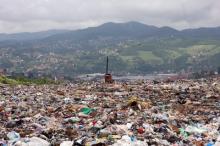
Waste management in remote areas, or where waste generation temporarily increases, makes it difficult to justify large-scale infrastructure development. To address this, the RECLAIM project has developed a low-cost, portable, AI-powered robotic material recovery plant, which will initially be deployed in the Greek Islands.
Applications are open for hosting EU Green Week 2025 partner events! Interested in hosting an event to raise awareness about the circular economy? Read the guidelines and apply now!
The EU Green Electronics Working Group brings together representatives from Horizon Europe projects dedicated to promoting greener and more sustainable electronics across Europe. The goal is to enhance visibility and coordination between them and advance green electronics by developing innovative materials, next-generation manufacturing processes and improved recycling techniques.
This Circular Talk focused on research into the circular built environment.
Researchers and policymakers talked about their publications, and a comprehensive reading guide was presented which summarises these and other key publications to help participants navigate the wealth of information available on the circular built environment.
Are you struggling with plastic waste reduction, rising sustainability demands or compliance with sustainability regulations? BALTIPLAST invites you to an event where you’ll learn about practical approaches to reduce plastic waste, improve sustainability and stay ahead of regulations with cost-effective solutions - without disrupting your operations.
The circular economy can help us address many of the crucial challenges and problems that we and our planet face today, such as wastage in different forms, resource depletion and climate change. Cities have a very important role in the circular transition as cradles or ecosystems and catalysts for circular change.
This guidance document outlines why cities should actively engage in and support others in the circular transition and how they can do that through 15 circular steps. The steps are divided into three phases: prepare and plan, facilitate and act, and invest and implement.
CARE is an innovative Horizon Europe project that aims to promote sustainable living and combat climate change. It's now inviting households in Finland, Norway, Sweden, Estonia and Germany to join its Circular Food and Clothing pilot projects.
Starting in summer 2025, over 100 households will embark on an 18-month journey to reduce food waste and extend the life of their clothes, supported by individual data, expert advice and a strong community. Register now!
The BIOTRANSFORM project (Circular BIOeconomy TRANSFORMation for regions by enabling resource and governance networks) is hosting its final event. Come and find out about the project’s key achievements, practical outcomes and future potential to support Europe’s transition to a circular bioeconomy!