On 5 September, ZeroW will be holding a workshop bringing together a diverse group of stakeholders, research institutions, startups, industry associations, regulatory authorities and more. They will discuss how to market innovative food loss and waste solutions produced during the research and development stage of EU projects.
Resourceful Cities was an URBACT Action Planning Network of nine European cities. The project sought to develop the next generation of urban resource centres. These resource centres see waste as a source of raw materials, thus acting as catalysts for the local circular economy.
The EU-funded 3R Connect project has established a common roadmap based on the existing strategies of the regions of Flanders, Greater Copenhagen and Northern Portugal. The goal is to accelerate circular transformation within the plastics, textiles and construction sectors.
The completed project has produced three comprehensive Joint Action Plans for Circular Economy in Plastics, Construction, and Textiles. These action plans are the culmination of an initiative that pooled input from over 200 private, public and research actors. Through their collective expertise, 3R Connect identified actionable strategies to accelerate the transition to a circular economy in Europe.
The action plans can be used by other regions: for instance, they can identify partners and join specific actions.
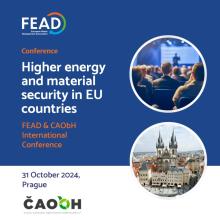
FEAD, the European Waste Management Association and CAObH, the Czech Circular Economy Association, will be holding an in-person conference in Prague on 31 October. It will bring together industry leaders, policy makers and experts to discuss key topics in the waste sector, including energy, recycling, climate and economy, and water.
Bio4HUMAN is a Horizon Europe-funded initiative working to solve solid waste management challenges in humanitarian settings.
This September, it will be holding a webinar on empowering the bio-based sector for solid waste management in humanitarian settings. The webinar will focus on the findings of their Humanitarian Needs Assessment Report and familiarise bio-based stakeholders with humanitarian settings and the challenges facing them in terms of solid waste management.
The REFLOW project sought to understand and transform urban material flows, and to co-create and test regenerative solutions at business, governance and individual levels to create a resilient circular economy. Projects were carried out in six pilot cities, covering areas such as textiles and energy from waste.
SISTERS is an EU H2020-funded project that aims to design, implement and promote innovations to address bottlenecks at each stage of the food value chain. The end goal is a systemic reduction in food loss & waste.
The GLOPACK project investigated food packaging with no environmental footprint and the ability to extend the shelf life of food products.
It focused on biodegradable and home compostable food packaging made from agro-food residues, bio-packaging and battery-free RIFD bio-sensors to track food freshness.
The Horizon Europe FISSAC project aimed to develop and demonstrate a new paradigm built on an innovative industrial symbiosis model. This model was intended to deliver a zero waste approach in the resource-intensive industries of the construction value chain.
The CircE Project (European regions toward Circular Economy) was an Interreg Europe project implemented during the 2014-2020 financing period. It aimed to reinforce the take-up of the circular economy in Europe.