Reverse Resources is an Estonian company that offers an online “circular” solution that tracks and traces waste flows by connecting manufacturers, waste handlers, recyclers/spinners and brands on one platform by offering 360 degree transparency, data accuracy and real-time transactions on waste flows.
About 50 per cent of the greenhouse gas emissions are related to materials and the manufacturing of products. Strong Circular Economy policies are therefore needed to meet the climate goals. Ecopreneur.eu has worked out far-reaching proposals as input for the EU Green Deal.
As global leaders gather in New York for Climate Week NYC in September 2019, the Ellen MacArthur Foundation has issued a new paper, in cooperation with Material Economics. As set out in Completing the Picture: How the Circular Economy tackles Climate Change, moving to renewables can only address 55% of global greenhouse gas emissions. It is urgent to tackle the remaining 45%.
The Elephant in the Boardroom: Why Unchecked Consumption is Not an Option in Tomorrow’s Markets is a working paper from the World Resources Institute that can guide discussion within companies about an uncomfortable truth: many of today’s business models are not fit for tomorrow’s resource-strained world.
Normalizing the conversation will set the groundwork for the pursuit of new business models that allow growth within the planet’s limits and generate stakeholder value in new and exciting ways.
The Boston Consulting Group (BCG) has released a report on tackling plastic waste using circular solutions, with a focus on the opportunities chemical recycling provides. After highlighting the scale of the issue, the report presents different ways of solving the plastic waste issue by comparing the impacts of different waste treatment options and technologies, such as pyrolysis. The report concludes that:
“To tackle the colossal societal and environmental issue of plastic waste, we need proportionally meaningful efforts from the private and public sectors as well as society at large that encompass behaviors and habits. The ultimate solutions will involve a combination of judicious consumption and disposal measures.
WRAP is a global environmental action NGO transforming our broken product and food systems to create circular living for the benefit of climate, nature and people. It aims to embed circular living in every boardroom and every home.
For over twenty years, WRAP has delivered programmes to benefit the environment, from reducing CO2 emissions and waste to restoring nature and enhancing people’s lives. It began in the UK in 2000 but is now global in scale.
Its goal is to drive the transition to a circular economy by keeping products and materials in use for longer, supporting innovation, adopting new business models and increasing the amount of material that is reused or recycled, as well as minimising waste and reducing the reliance on virgin materials.
Suckõrs is an Estonian company that uses reed growing naturally on the shores of Estonia to make reusable, biodegradable drinking straws and a new raw material for producing goods. Their products can be cleaned and reused multiple times and, once they have reached the end of their lifecycle, they will decompose naturally.
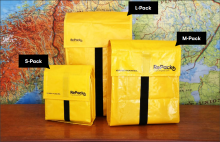
RePack is the easiest way to implement circular economy in eCommerce. Using reusable and returnable RePack packaging service means sustainability in every package.
The reusable RePack bags are and made of durable and recycled materials and come in three adjustable sizes. They replace single-use packaging as the customer chooses RePack as the mean of package for delivery.
Sulapac has developed a fully biodegradable and microplastic-free material which can replace plastic. The bio-based material is both recyclable and mass-producible and is available as granules or final products.