KLIMIS has been using the woody part of Greek olive pits as heating fuel for its lime production since 1968. In 1992, it developed a patented process to recycle the residual material from this combustion into highly-efficient, low-emission barbecue briquettes.
The Circularity Gap Report 2019 finds that just 9% of the 92.8 billion tonnes of minerals, fossil fuels, metals and biomass that enter the economy are re-used annually. Circle Economy calculates that 62% of global greenhouse gas emissions are released during the extraction, processing and manufacturing of goods to serve society’s needs; only 38% are emitted in the delivery and use of products and services.
It highlights the vast scope to reduce greenhouse gas emissions by applying circular principles - re-use, re-manufacturing and re-cycling - to key sectors such as the built environment. Most governments barely consider circular economy measures in policies aimed at meeting the UN target of limiting global warming to 1.5°C above pre-industrial levels.
Encourage individuals and organizations to contribute to a more sustainable use of electronics by sharing tips and inspiring others to re-use products with the hashtag #CircularElectronicsDay!
Scientific journal Nature addresses setting up an international platform to share data and experiences, and coordinating industrial policies and trade to conserve resources and energy.
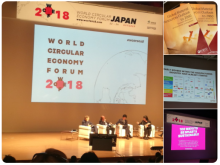
The World Circular Economy Forum 2018 took place in Yokohama, Japan, from 22 to 24 October. ECESP was represented by Ladeja Godina Košir, coordination group member for Circular Change.
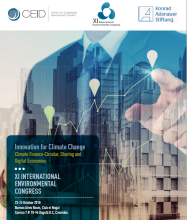
The XI International Environmental Congress took place in Bogotà, Colombia on 23 and 24 October 2018, with participation from Cillian Lohan, ECESP coordination group member for the EESC.
The Relooping Fashion Initiative (2015-2017) was aimed at piloting and modelling the circular business ecosystem for textiles. This report covers the business ecosystem modelling work and introduces the project team’s crystallized vision of a higher-level system that enables the textiles industry to operate according to the basic principles of a circular economy.
The focus of the report is on explaining the principles of a circular economy in the context of textiles, and drawing a picture of the key material flows and types of actors along the value cycles from end-user back to end-user. The overall goal is to maintain the value of materials as high as possible, with minimum environmental impact. The different circular business models for textiles are introduced along the value cycles.
Renewcell's technology dissolves used cotton and other natural fibres into a new, biodegradable raw material: renewcell pulp. It can be turned into textile fibre, be fed into the textile production cycle and meet industry specifications. This is the link that has been missing from the cycle, and will enable the way fashion is produced and consumed to be transformed into a never-ending loop.