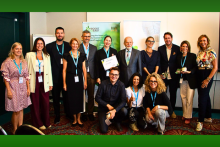
Taking place on 10 September, the BIOEAST Slovenia-Croatia Pitching Event 2026 aimed to take ideas from 'well, it sounds interesting' to 'this will work'.
Innovators and experts explored what it takes to build a stronger circular bioeconomy, while participants presented their innovations, received expert feedback and connected with potential partners.
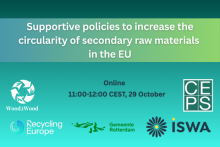
Each year, tonnes of valuable materials are disposed of rather than being recovered – partly because Member States have varying quality standards and requirements for embedding recycled content in new products.
This webinar will examine how EU policies can increase the availability of and demand for secondary raw materials, especially from wood waste.
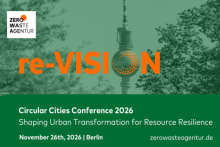
What do circular cities need to really make an impact? What ideas can get us out of the endless discussion loop and into action? And how do big visions turn into real commitment?
This event organised by Berlin's zero waste agency will be looking to find answers to these questions!
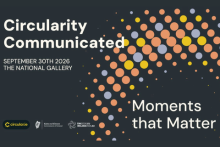
This report is part of the overarching project Circular.ie and was presented during the inaugural conference 'Circularity Communicated' in Dublin, on 30 September 2026.
It brings together insights from national public opinion research, behavioural research, campaign performance data and community-level activity to provide a comprehensive picture of public awareness, understanding and engagement with the circular economy in Ireland.
The report seeks to identify not only what the public knows about the circular economy, but also how awareness translates into understanding, trust, participation and behavioural change.
This year, this long-standing event will shift the focus to the circular economy. Six tracks of plenary sessions and workshops will stretch over two days, exploring topics such as reuse, responsible production and consumption, and anticipating future events.
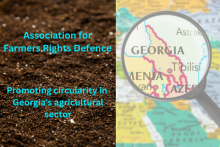
The Association for Farmers Rights Defence (AFRD) in Georgia is working with farmers, researchers, innovators, SMEs and local communities to develop circular value chains. Agricultural waste is used as a raw material, cutting waste and helping farmers.
Biogas Thrace S.A. is setting up three biogas plants which will be supplied with agricultural and industrial organic waste by a network of local farmers working on long-term contracts. The farmers will receive fertiliser and reduce their waste disposal costs, and the plants will each generate 24GWh/y.