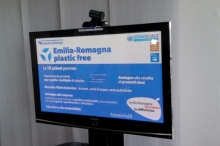
PlasticFreER is the Plan approved by the Emilia Romagna region (IT) Executive in 2019 for a shared strategy with public bodies, businesses, trade unions, associations and the scientific community to free offices, canteens, festivals and parties from disposable plastic and clean up public spaces, rivers, sea and beaches.
A common path in 15 actions for an increasingly circular and sustainable economy.
Reconvert, reduce and clean up: three pillars of the rule approved by the regional government which translate into support, with funds and incentives, for the conversion of companies producing plastic - particularly single-use.
Aid to public bodies and private individuals who decide to reduce their use and a special cleaning project to remove waste from the beds of waterways/sea.
The Circular Plastics Alliance aims to boost the EU market for recycled plastics to 10 million tonnes by 2025. The alliance covers the full plastics value chains and includes over 175 organisations representing industry, academia and public authorities. New stakeholders can join the alliance by signing its declaration.
This report explores the implications of the transition towards the circular economy for the Scottish labour market. It presents a baseline measurement of the number and geographical distribution of jobs currently related to the circular economy in Scotland and explores the types of circular jobs, roles and skills associated with opportunity areas in three value chains: construction, bioeconomy and capital equipment.
Circle Economy and Zero Waste Scotland designed this report to support enterprise agencies, workforce development, governments, universities, employers and other representatives to recognise the potential of the circular economy for the Scottish labour market and the related skills development needs of its workforce as part of a just transition.
Finnish jewelry company EKORU makes jewelry out of discarded Finnish coins, old silver spoons and other cutlery. After Finland changed to the Euro, the metal of old Finnish coins found other purposes.
Saccharides are a valuable and readily available source of renewable carbon. There are unique opportunities to produce renewable intermediate chemicals and polymers from regionally available agricultural products and imported feedstock in the period up to 2050.
Industry in the Chemport region (Northern Netherlands) has several options to further reduce CO2 emissions, including recycling or circular chemistry and shifting towards bio-based feedstock, acting as a catalyzer for other industries.
Important focus areas of the saccharide roadmap are:
developing technologies/markets
strengthening/expanding feedstock production
developing incentives/regulations
further developing an integrated approach, cooperating and improving the knowledge base.