The BlueCity business park is one of Rotterdam's unique landmarks: formerly a water park resort, the complex is now a circular incubator housing over 30 startups experimenting towards a sustainable future.
Public authorities will soon be encouraged to apply the Lifecycle Assessment (LCA) approach to their policies thanks to a new Interreg Europe project, LCA4Regions. The 9 project partners met for the first time in Brussels, on 30 September and 1 October 2019, the with support of ACR+.
The Finnish city of Lahti has been pioneering industrial symbiosis at the Kujala Waste Treatment Centre where all sorts of waste are reused. Several companies have established interconnected material flows, thus making one’s residues another one’s raw materials.
Vlaanderen Circulairis the hub and inspiration for the Flemish circular economy. It is a partnership of policy makers, companies, civil society and the knowledge community taking action together. Its six core activities are:
Bringing together partners to tackle circular economy challenges
Creating knowledge to streamline policy-related research into policy measures for the circular economy in Flanders
Speeding up innovation and entrepreneurship
Assisting pioneers
Connecting local, Flemish, federal and European policy making
Embedding circular principles across Flemish civil society.
To prevent consumers from buying items they use only a few times a year, Usitoo enables customers to rent these instead. The cooperative has a catalogue of hundreds of items that its customers can rent with credit, thus making the possession span of these items much longer.
In the framework of the CIRCWASTE project, coordinated by SYKE (Finnish Environment Institute), pioneering municipalities have developed local circular economy (CE) roadmaps in 2019.
The town of Riihimäki, already a member of FISU (Finnish Sustainable Communities), a network of Finnish municipalities committed to becoming waste-free, has adopted a CE roadmap focusing on the participation of local actors.
The roadmap covers five themes:
Carbon neutral energy production and consumption
Sustainable circulation and ecologically efficient town structure
Sustainable consumption of natural resources and CE
Diversity of nature and comfortable living environment
Inhabitant responsibility.
The Riihimäki roadmap also includes commitments to CE by local companies and communities.
In the framework of the CIRCWASTE project, coordinated by SYKE, pioneering municipalities have developed local circular economy roadmaps in 2019. This roadmap, adopted by Vantaa, Finland's fourth biggest city, is based first and foremost on what stakeholders identify as local strengths, special characteristics and challenges.
The roadmap lists the priorities, objectives and actions to take in 2019-2030 that could a promote circular economy locally. Its priorities are :
circular business models
circular economy in construction
circular public procurement
sharing economy.
The objectives are to be reached by 2030 in four timeframes, with responsibility for implementation shared among several local stakeholders that vary from municipal utilities to private companies.
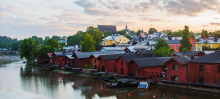
In the framework of the CIRCWASTE project, coordinated by SYKE (Finnish Environment Institute), pioneering municipalities have developed local circular economy roadmaps in 2019. The City of Porvoo is one of these and published its own circular economy roadmap in May 2019 to steer efforts that promote resource efficiency and circular economy in the coming years, so it can build on successes to date that range.
A steering group of 16 municipal civil servants and other local stakeholders drafted this roadmap, which focuses in particular on the following objectives:
increasing the use of recycled materials in excavation and building sites
cooperating to improve energy efficiency
reducing the amount of total waste while increasing the level of recycling municipal waste.
In the framework of the CIRCWASTE project, Southwest Finland developed a circular economy (CE) roadmap in late 2018 to help implement the national waste plan and define regional objectives with concrete measures to achieve these.
The Finnish Environment Institute formed an expert network on CE, and began identifying regional strengths and special characteristics to start with.
While the overarching theme is public procurement, the regional strategy focuses on the following sectors:
construction and demolition waste
biodegradable waste, biogas and the nutrient reuse
plastics
electric and electronic wreckage.
Different stakeholders, from municipal/regional authorities, to national institutes, educational establishments, and private companies take responsibility for implementation.
In 2018, Finland's easternmost region of North Karelia adopted a circular economy (CE) roadmap as part of the CIRCWASTE project. Its objectives are to:
enhance material and energy efficiency and improve natural resource use
make circular economy inherent to industrial production in priority sectors and strengthen the regional cooperation network in the field of CE
strengthen and stimulate new circular business models while developing new technological solutions and know-how in the region.
Regarding waste management overall, the strategy aims to increase knowledge and change overall consumer attitudes.
A system to recycle construction waste is set for development, focusing on logistics, demolition methods and supervision. This strategy aims to improve training on waste management.