This all-day event in Brussels on 17 April will feature four expert-led sessions, each focusing on different aspects of how circular economy principles can ensure that the built environment remains within planetary boundaries.
The sessions will explore regenerative design, business cases, circular scenarios and blueprints for solutions.
With the 9 Ilhas Circulares website, the Portuguese public authorities aim to promote a more sustainable lifestyle on the Azores islands.
It is a collaborative online space for exchanging or selling surplus materials, secondhand items and circular services.
This online marketplace has 525 registered users. It fosters a culture of sharing among community members and facilitates donations, with a focus on supporting those in need. In addition to showing products to buy or sell, the platform offers access to a variety of repair, recycling and upcycling services. It has a section on good practices and a space for promoting companies and entities with a sustainable business model.
In 2022 the Podravje region (Slovenia) became part of the Circular Cities and Regions Initiative (CCRI) and was selected as one of the 12 CCRI pilots being supported for the implementation of Circular Systemic Solutions (CSS) which could provide answers to major challenges beyond resource management and waste/water recovery.
The region is now developing a circular bioeconomy strategy which is the key document describing the available regional resources and linking them to suitable CSSs.
So far, two rounds of consultations with regional stakeholders have been organised and 9 key CCSs have been identified as the key activities within 4 priority areas:
The European Green Deal is a cornerstone of efforts to achieve climate neutrality by 2050 and deliver the Sustainable Development Goals in the EU. Many policy targets are dependent on action by local and regional authorities.
The current Commission's mandate is coming to an end, and so this is a good time to kick-start discussion on the "future" Green Deal and the role of local and regional authorities in implementing it.
The European Commission’s Joint Research Centre is therefore launching a stakeholder consultation for urban policy experts and policy makers, in order to get a better understanding of policy and target priorities for EU cities.
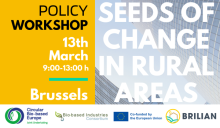
The BRILIAN project workshop "Seeds of Change in Rural Areas" will address several crucial policy-related topics, including developing new materials from agricultural feedstocks.
There will be presentations by representatives of the European Bioeconomy Bureau, the Circular Bio-based Europe Joint Undertaking and the European Commission's Joint Research Centre (EC-JRC), as well as a round table session on unlocking resources from agricultural produce and waste.
Co-organised by the European Commission’s Circular Cities and Regions Initiative (CCRI) and its strategic partners, the Organisation for Economic Co-operation and Development and the European Investment Bank, this hybrid WCEF accelerator session will focus on how EU cities and regions are moving ahead with the circular transition.
Following a request by the Belgian Presidency of the Council of the European Union, the European Committee of the Regions is preparing an opinion on What is the role of local and regional authorities in the transition towards a circular economy? The opinion is being drawn up by Loredana Capone, president of Apulia Regional Council (Italy).
This stakeholder consultationis intended to provide Ms Capone with input for the opinion.
The BRINC(Brokering cross-border Innovation through Clusters) project is holding a workshop where participants will be able to meet the BRINC network of public authorities and other key actors working on public procurement of innovation and circular economy in order to exchange insights and learn from each other.
On 22 February, Tondo will present the report on the Taranto Circolare project in a webinar.
Taranto Circolare has conducted an in-depth study of the level of circularity in the Taranto area. Tondo's team focused on material and energy flows in the macro-sectors of the province of Taranto in 2020, covering inputs, outputs, waste and emissions, and quantifying the region's level of circularity.
Nordic Innovation has set up the Nordic Circular Accelerator programme, a free, one-year programme to help you and your partners scale up your circular efforts. It gives participants access to a network of cross-industry leaders and experts in circularity and data, one-to-one guidance and the opportunity to learn from companies.