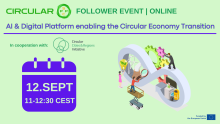
CircularPSP (Public Service Platforms for Circular, Innovative and Resilient Municipalities through pre-commercial procurement) is organising a Follower Event in cooperation with CCRI.
The event will showcase the outcome of the CircularPSP Tender and current work. There will be presentations on the challenges to the circular economy transition and the approaches taken by five selected suppliers, and an update on the CE Taxonomy and CircularPSP Roadmap.
On 14 June, as part of the activities of the Belgian Presidency of the Council of the European Union, the Public Waste Agency of Flanders (OVAM) held a workshop on the future of the EU Waste Framework Directive.
The main findings of the workshop are set out in the event report, including key recommendations for the European Commission.
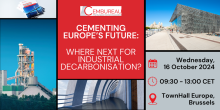
CEMBUREAU, the European Cement Association, invites you to take part in its annual conference. This year, the focus will be "Cementing Europe's Future: Where Next for Industrial Decarbonisation?"
The event will take place on 16 October at TownHall Europe, Brussels although it will also be possible to take part remotely.
This report aims to shed light on the carbon footprint of the retail and wholesale sector in Europe and its value chains around the world. Besides providing insight into the status quo, it aims to set out a path towards a more sustainable future across four retail and wholesale subsectors:
food and beverage and health and beauty
textile and apparel
consumer electronics, and
home and do-it-yourself.
The study points out that there are four decarbonisation levers for retailers and wholesalers, including improved product circularity and improved packaging circularity.
The publisher hopes that this study will provide policymakers with actionable insights.
The Mediterranean is facing rising challenges related to environmental degradation, biodiversity loss, pollution, overpopulation and water scarcity. These issues are exacerbated by heatwaves, droughts and coastal vulnerabilities. This means that there is a critical need for an immediate transition to a green, circular economy in the Euro-Mediterranean region.
This report looks at the state of play there, the challenges to be faced and the role of stakeholders. It is intended to help policymakers align decisions and strategies for sustainable economic development and to provide up-to-date information for funding agencies, businesses, researchers, academics and civil society organisations advocating for green and fair policies in the Mediterranean region.
Circular Week is an international series of events and initiatives dedicated to the circular economy and sustainable development, taking place across Europe. This year, the event will take place on 21-25 October.
Any company, individual, institution, association or other entity which would like to be a co-organiser and partner of Circular Week can host their own event from 21-25 October. Events can take the form of conferences, educational workshops, seminars, webinars and more, in any format and in any location. Do you have an idea for an event? Submit it!
CircularB (Implementation of Circular Economy in the Built Environment) aims to develop a common international framework for a circularity rating tool with Key Performance Indicators.
They have therefore launched an international survey to gather fresh insights into the technological, economic, cultural-societal, and regulatory barriers to circular economy implementation in the construction industry.
CircularInvest provides tailor-made support to improve projects' circularity, develop a business plan (including IP and legal aspects), and make circular economy projects more appealing to investors.
Apply now to get free project development assistance to increase your project’s investment readiness!