BUILD UP, the European portal for energy efficiency and renewable energy in buildings, is hosting the third in a series of six webinars organised with the CircularB COST Action project. This one is on Investors, Developers and Insurance Providers.
It will explore successful projects and the challenges they face while implementing circular principles in the construction sector.
The European community PACCT for Sustainability (Product as a service to Accelerate Cooperation and Circular Transformation) will host a webinar on 25 June to explore how to finance product-as-a-service models.
Participants will be able to interact with RISE, ABN-AMRO and LINXFOUR, who will be talking about their experiences.
The FOODY EU project promotes entrepreneurial skills and employment of young people, using circular economy principles to combat unemployment. It provides comprehensive information on the management and environmental impacts of food waste, using the food industry and waste management sector to instill in young people the value of resource conservation.
ISO 59020 covers Circular economy — Measuring and assessing circularity performance.
It provides a structured approach for organisations to measure and assess their circularity performance. It aims to standardise the process by which organisations collect and calculate data, using mandatory and optional circularity indicators.
This standard will:
help organisations align with global sustainability goals
enhance transparency and accountability in environmental reporting
support strategic decision-making for sustainable resource management.
You can read a sample or purchase the full version on the ISO website.
Together with ISO 59004 and ISO 59010, these standards offer a complete toolkit for achieving a circular economy, from principles to measurement.
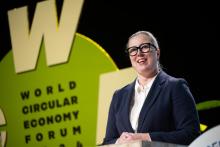
During the World Circular Economy Forum 2024, the European Commissioner for International Partnerships Jutta Urpilainen announced two initiatives intended to advance the circular economy at global level.
The establishment of the EU Circular Economy Resource Centre under the Global Gateway strategy will facilitate peer-to-peer exchanges and partnerships between EU and third-country stakeholders, fostering the uptake of sound circular economy policies and business models worldwide. The Commissioner announced a EUR 15 million commitment from the European Commission.
In addition, Commissioner Urpilainen launched the "SWITCH to Circular Economy in East and Southern Africa” programme. The European Commission will contribute EUR 40 million over five years to this programme, which will promote the transition to circular economies.
ICLEI - Local Governments for Sustainability is a global network of more than 1 750 local and regional governments committed to sustainable urban development. Active in over 100 countries, ICLEI influences sustainability policy and drives local action for low emission, nature-based, equitable, resilient and circular development.
Simon Clement joined ICLEI Europe in 2002. As Head of Circular Economy, he is responsible for ICLEI's activities in this field, including managing the European Circular Cities Declaration. For over 20 years he has worked for, and on behalf of, local, regional and national governments in project, policy and strategy development on sustainability issues such as circular economy, procurement, transport and smart cities.
This session will present the findings of innovative demonstration projects on net zero emission and plus energy neighbourhoods around Europe, as well as the viewpoints of key stakeholders along the value chain. It will also explore the policy measures needed to finance and scale up such projects around Europe.
The main outcome will be a list of policy recommendations for private and public decision makers.
The European Commission has announced a EUR 40 million investment in the SWITCH to Circular Economy in East and Southern Africa (SWITCH-2-CE in ESA) programme.
This programme aims to advance circularity in Eastern and Southern African countries as they shift from a linear to a circular economy. It will do so by creating an enabling environment for investment in circular business models and improving access to the necessary skills and finance.
From 15 to 18 April, circular economy professionals from 168 countries came together at WCEF2024 to collaborate and turn ideas into action.
The Summary Report takes stock of the event: it presents the findings and key takeaways, including reports, tools and calls to action launched at the forum by partners, discussion highlights and key statistics.
Companies in the electronics sector are stepping up their efforts to move to circular business models.
This document describes Circular Transition Indicators (CTI), a metrics framework positioned to be the universal language of circular performance and accountability. CTI enables businesses to assess circularity levels, set improvement targets and monitor progress.