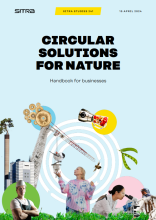
This is a comprehensive guide for businesses aiming to integrate circular business models into their operations with a view to effectively addressing biodiversity loss.
It guides companies through the process of identifying and prioritising their most critical biodiversity impacts.
The Waste Framework Directive mandates that from 2025, EU Member States must establish separate collection systems for used textiles.
This briefing provides an overview of the state of play of textile waste generation, collection systems, treatment capacity and the different classifications for used textiles in Europe. It also identifies factors which must be considered when implementing separate collection systems, with a view to fostering the circularity of textiles without inadvertently increasing exports, incineration or landfilling.
It is underpinned by a report from the European Environment Agency’s European Topic Centre on Circular Economy and Resource Use.
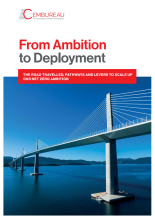
The publication of CEMBUREAU's Net Zero Roadmap is a key moment for the EU cement sector: the roadmap looks at its climate ambition, the key levers to decarbonise cement production, and the policies needed to get there.
Cement and concrete are also going circular. Circularity is an integral part of the net zero ambition, allowing for significant CO2 reduction throughout the cement and
concrete value chain. Over the past decades, the European cement industry has promoted circularity by using waste materials to make cement, both as raw materials and as fuel in its kilns.
This shift has picked up the pace over the last few years, with the adoption of new methods to develop the role played by cement and concrete in the circular economy.
The GO-GRASS evaluation tool provides valuable insights and recommendations to help users make informed decisions about a business idea related to the processing of grass. The tool offers insights about critical factors and best practices, based on the four GO-GRASS demonstration sites and possible value chains for grassland valorisation.
Wales (Cymru in Welsh!) will be hosting the 2024 European Circular Economy Hotspot: Circular Economy Hotspot Cymru 2024.
The summit will take place on 7-9 October in Cardiff. It will be an opportunity to share Wales' circular economy achievements and aspirations, and learn about circular economy solutions from the public sector, private sector and communities from Wales and beyond.
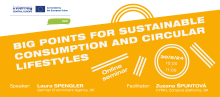
From Niche to Centre (City Centres as Places of Circular Lifestyles) is an Interreg Central Europe project. It aims to revitalise fading city centres by making local trade and consumption more circular and sustainable.
The project is organising a series of webinars: this one will explore Big Points for Sustainable Consumption and Circular Lifestyles. It will identify measures that are particularly important for effective environmental and climate protection.
Tilos is a tiny Greek island, and in 2021 it undertook to become 'zero waste'. And it succeeded: in 2023, it was officially proclaimed a Zero Waste Certified City.
They achieved this by setting up the Just Go Zero Tilos project, in collaboration with Polygreen, a waste management company which provides solutions for industrial waste and marine pollution. The project successfuly minimised waste production and cut out landfilling.
Circe.med is a network of Mediterranean organisations involved in the transition towards ecologically and sustainable ecosystems. Established at the start of 2024, it wants to help deliver a carbon-free, circular economy which will improve people's quality of life.
The initiative aims to deepen, promote and implement a circular economy based on efficient and reduced use of natural resources.
Three main strands:
Sustainable food
Tourism and plastic in coastal areas
The built environment
The network's member organisations strive to deliver an effective circular economy in the Mediterranean which will benefit their individual ecosystems and the region as a whole.
The network is supported by an online platform, Circemed.org, which promotes cooperation and acts as a resource centre.
EFPIA, the European Federation of Pharmaceutical Industries and Associations, supports the principles of the Circular Economy Action Plan.
In the healthcare industry, circular opportunities could be centred around eco-design of products, packaging & devices, and end of life; circulation of products and materials to maximise the value of resources; reduction of reliance on single-use plastics, regeneration of natural systems by preserving finite materials and exploring renewable resources and associated services; suppliers and customer engagement for equipment return.
Safe and sustainable closed-loop recycling within the industry is the goal, but where this is not yet feasible, these valuable materials must be circulated as secondary raw materials for other sectors.
World environmental challenges such as climate change and biodiversity loss pose considerable risks to health and well-being. Linear resource extraction and processing account for half of total greenhouse gas emissions and more than 90% of biodiversity loss and water stress. Institutional and European stakeholders agree that transitioning to a circular economy could help solve these existential crises.
With the coming change in the European political landscape, the members of the Coordination Group of the European Circular Economy Stakeholder Platform want to flag up this issue to incoming legislators and advocate keeping the Green Deal and the circular economy as a primary focus for the next Commission and European Parliament.