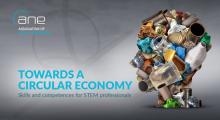
The benefits of transitioning to a circular economy outweigh the disadvantages. However, more efforts are needed to move from conceptualisation to implementation. The transition requires a political commitment and the right business mindset. It also requires prioritisation and investment in innovation, the utilisation of new technological solutions, and the right set of skills and competences.
So far, there has been very limited focus on what skills and competences are needed for this transition and whether Nordic STEM education provides them. This report introduces the basis for a Circular Economy Competence Framework for STEM specialists, including a set of essential technical and analytical skills for creating circular solutions.
On the Green Track is an EU campaign on biodiversity and nature for young people, organised in collaboration with the Global Biodiversity Youth Network and implemented in spring 2022 during the European Year of Youth.
You or your organisation can contribute to the debate about the future of nature and biodiversity by organising a youth-focused event and hence become one of the Green Track Stops.
This online course is accessible to all professionals and individuals, from entrepreneurs to business owners and project managers who want to learn how to design resilient and profitable business models with circular economy principles. In this 15 hour, self-paced course, you will learn the basics of business ecosystem design and how to put the circular design approach into practice.
The Environmental change project promoted proactive reskilling and upskilling to reap the benefits of the ecological transition. The project was in line with the European Green Deal and focused on the circular economy and sustainable solutions.
The French National Institute for Circular Economy (INEC) has published this paper which aims to use schools - a place familiar to all - as showcases for the circular economy. It contains a series of good practices (for public and private actors, youth) comprising over 40 territorial initiatives and 50 operational solutions, on the following themes:
school buildings (construction, renovation)
energy supply
inner/outer spatial planning
stationery-equipment-furniture
school cleaning (products and apparel, staff training)
food loop (local and sustainable food, waste, water fountains)
Circular Valley aims to establish a future-oriented circular economy.
It was founded in 2021, and already over 100 startups from all around the world have participated in its Circular Economy Accelerator.
It is funded by the North-Rhine-Westphalian Ministry of the Economy with a view to leveraging and developing the region's strengths through innovative circular economy concepts, products and business models.
Members can connect up with 140+ partners from industry, R&D and government from the Circular Valley network. The platform also organises expert workshops, tailor-made training sessions and an intensive coaching and mentoring programme.
Welcome to the circular economy event of the year, World Circular Economy Forum 2021, on 13-15 September 2021!
Hosted for the first time in North America, WCEF 2021 will focus on the system level changes, or “game changers,” needed to accelerate the transition to a circular economy.