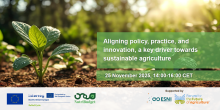
Co-hosted by the NutriBudget and ReNu2Cycle projects, this webinar will bring together leading experts, practitioners and policymakers to explore how policy can drive the adoption of sustainable farming practices through better circular use of nutrients.
The University of Copenhagen and the Danish Ministry for Green Transition, on behalf of the European Commission, are hosting a conference which aims to advance the EU’s green transition through bioeconomy, food systems and biodiversity.
The event will explore how to boost and mainstream the bioeconomy through science, innovation and governance, using and reusing all parts of biomass.
This conference will explore how to make circularity work on the ground. There will be short sessions on the Circular Economy Act and Dialogue on the circular economy, followed by a panel discussion on whether including the waste sector in the Emissions Trading System will be a boost or a barrier to circularity.
This session will launch RREUSE's report on targets for reuse and preparing for reuse in the European Union. It will delve into the report’s key findings and explore how ambitious, measurable reuse targets can accelerate Europe’s circular economy transition.
The CityLoops project was a Horizon 2020 project which ran from 2019 to 2023. It focused on circular economy solutions for bio-waste and construction and demolition waste (CDW). The project produced various tools, including these recommendations.
CityLoops (Closing the loop for urban material flows) was a Horizon 2020 project which focused on circular economy solutions for bio-waste and construction and demolition waste (CDW). Seven European cities implemented ten demonstration actions and tested over 30 new tools and processes, which are available together with replication packages and feedback from the cities which tested them.
The EU Ecolabel is the official European Union voluntary label for environmental excellence. See why it's good for the circular economy (and consumers!), have a look at the latest figures and watch the video on why public procurers should choose EU Ecolabel certified products.
The European Commission has launched a call for evidence on advanced materials, which will feed into the Advanced Materials Act. See what it's about and give your views!
The ECCA has been set up by the European Composites Industry Association (EuCIA) which represents European national composites associations and industry-specific sector groups at EU level.
It was launched in 2025 to establish a circular economy for composites in Europe. It provides a platform for knowledge sharing and cooperation, driving collective action to establish truly circular, sustainable value chains for composite materials. It will set and achieve targets on the use of recovered and recycled composites, develop standards for circular product design and provide a forum for the industry.
Stakeholders across the composites value chain can join the ECCA by signing the declaration. They can then join one of the five working groups, from aerospace to construction to policy/regulation.