The 4th International Conference on Strategies toward Green Deal Implementation – Water, Raw Materials & Energy (ICGreenDeal2023) will take place on 14-15 December. It will tackle climate change and ways to prevent it, including innovative solutions (technological, environmental, economic and social) that can be implemented under the Green Deal Strategies.
Pathways2Resilience is a flagship project under the EU Mission on Adaptation to Climate Change, working to empower 150 regions in developing transformative adaptation plans.
Join the Pathways2Resilience launch conference on 23 November and help shape a common vision for regional climate adaptation.
Join the launch of the Global Action Partnership for Extended Producer Responsibility (GAP for EPR) on 19 October at 14:00 CEST!
GIZ, WWF and the OECD are partnering up to establish the Global Action Partnership for Extended Producer Responsibility, hosted by the PREVENT Waste Alliance. This partnership also receives circular economy support from the Ellen MacArthur Foundation and is working closely with UNEP to provide technical support to governments and PROs. Register now for this online event!
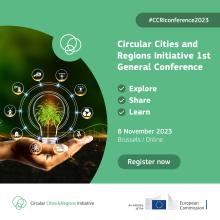
Registrations are now open for the Circular Cities and Regions Initiative (CCRI) first General Conference “From vision to reality: Cities and regions drive forward Europe's circular transition”, to take place on 8 November in Brussels and online.
About 200 participants will have the chance to attend in person. Learn about opportunities for scaling up circular solutions, exchange ideas with stakeholders and pave the way for Europe's circular transition.
On 9 November, CCRI stakeholders will be invited to attend the second CCRI Coordination and Support Workshop where they will be able to take part in a matchmaking experiment. Register for the Conference today!
The Expert Forum on Materials for Battery Innovation will take place on 11 October in Darmstadt. It will spotlight the vital role that materials play in driving innovation in the field of batteries. Recognising the increasing importance of energy storage for various applications, stakeholders from the EIT RawMaterials network will gather to discuss cutting-edge materials research, manufacturing techniques and sourcing principles that can enhance battery performance, safety and sustainability.
The forum will provide a platform for collaboration and knowledge exchange to accelerate the development of advanced battery technologies and skill sets.
This launch event on Regional Innovation Valleys for Bioeconomy and Food Systems will take place on 13 October 2023. It is organised jointly by the European Commission's Directorate-General for Research and Innovation and the Agricultural University of Plovdiv, in close cooperation with the BIOEAST Initiative. It will be webstreamed and recorded.
This white paper examines China's transition to a circular economy.
A new plan for China’s circular economy (CE) was set out in the 14th Five-Year Plan 2021-2025. Circular Innovation Lab's previous paper on China’s Circular Economy Policies: Review and Reflection argued that there has been significant improvement in environmental aspects in China. It also identified challenges in the implementation of past five-year plans, such as coordination challenges, uneven and unsustainable development, and lack of research.
This paper builds on those findings to address the way forward in China's CE transition, including challenges and opportunities.
More than 140 million SMEs make up a significant part of China's economy and technological innovation.
However, they are also responsible for significant environmental issues, with most environmental regulation violations in China being incurred by SMEs. This paper investigates how SMEs can help China transition to a circular economy by harnessing their potential for technology innovation and flexibility in adopting circular practices. By looking into the development characteristics of Chinese SMEs, it highlights the implications for SME-related policies and management and emphasises the need for collaboration between businesses, NGOs and individuals.
By tapping into their strengths, SMEs can play a vital role in delivering the successful transition to a circular economy in China.
The circular economy was introduced in China’s policies in 2002 and has evolved into a national strategy and a fundamental pillar of the economy. However, while the efforts so far are worth celebrating, issues such as coordination challenges, uneven development, unsustainable success, and a lack of research are still undermining China's circular development.
This paper builds a primary framework by reviewing the development of China's circular economy policy. The paper consists of a policy review, the implementation and the corresponding outcome, challenge identification, framework establishment and application.
The Pop-Machina project consortium is thrilled to invite policy stakeholders and decision-makers to participate on 14 September 2023 in its upcoming International Policy Roundtable focusing on the policy recommendations and lessons learnt during the project on circular economy, the maker movement as well as their convergence.