The Pop-Machina project consortium is thrilled to invite policy stakeholders and decision-makers to participate on 14 September 2023 in its upcoming International Policy Roundtable focusing on the policy recommendations and lessons learnt during the project on circular economy, the maker movement as well as their convergence.
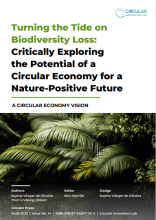
Global biodiversity is being lost at an unprecedented rate, giving rise to a sixth mass extinction and constituting one of the core challenges of the triple planetary crisis. Biodiversity forms the foundation of life on Earth and its loss presents a systemic risk to future human survival. To reverse the biodiversity crisis, transformative systems-wide change is required.
This paper addresses an existing research gap by exploring whether the circular economy can play a role not only in halting biodiversity loss but also in regenerating it and thereby contributing to a nature-positive future. To unlock the regenerative potential of the circular economy, a coherent strategy is needed that provides incentives for all actors, notably policymakers and businesses.
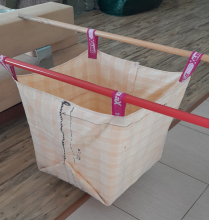
The Albanian social enterprise RecycAl reuses textile waste such as leather or canvas by turning it into heavy-duty bags that could be produced at industrial scale.
This Brussels based event on 21 November 2023 will bring together industry leaders, policymakers, and innovators to explore the path towards a more sustainable and circular textile sector.
Knof is a Slovenian social enterprise with a focus on circularity and sustainability. It operates reuse boutiques, a circular laboratory and a programme for individuals and entrepreneurs supporting sustainable companies.
Siptex is the world’s first large-scale facility for sorting textiles by colour and fibre composition through near-infrared light to handle large flows and produce textile fractions suited to different recycling processes. As textile waste is a growing concern around the world, innovative solutions are required to tackle this environmental problem.
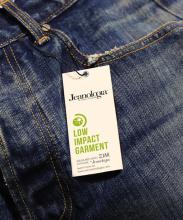
The Spanish company Jeanologia is currently spearheading the greatest challenge facing the textile industry: to achieve total dehydration and detoxification in denim industry. With Mission Zero the company is transforming the way jeans are made, from fabric to finish, minimising the use of water and chemicals to a close-to-zero target.
The Ellen MacArthur Foundation is a UK charity which aims to speed up the transition to the circular economy. Since it was set up, the charity has emerged as a global thought leader, putting the circular economy on the agenda of decision makers across business, government and academia.
The Ellen MacArthur Foundation is a UK charity which aims to speed up the transition to the circular economy. Since it was set up, the charity has emerged as a global thought leader, putting the circular economy on the agenda of decision makers across business, government and academia.
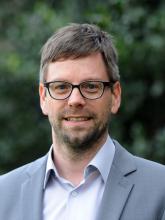
Carsten Wachholz joined the Foundation in 2020 after spending two years working for the European Investment Bank on Corporate Responsibility and another four years working for the European Environmental Bureau on the first EU Circular Economy Action Plan. Carsten leads the Foundation's newly established Brussels-based team supporting the development of circular economy policies at EU and international level (e.g. G20, OECD), in close collaboration with the Foundation's systemic initiatives on plastics, fashion and food.
This online session on 2 June 2023, from 10:00 to 12:00 (GMT+2), explores how cities worldwide can unlock the potential of the circular economy at the local level, while promoting biodiversity and nature conservation.