Fashion for Change EU - with contributions from Michael Laermann and Arthur ten Wolde (Ecopreneur.eu), Mari Saar (Civitta), Maria Kristiin Peterson (EKA), and Justina Lizikevičiūtė- Grišinė (Katalista Ventures)
This Fashion for Change report illustrates the key business challenges and needs for circular fashion designers, start-ups and small and medium-sized enterprises, along with proven and recommended solutions to support them.
The report recommends a hybrid community model that interconnects physical local competence centres with digital platforms and online networks to provide access to relevant information, contacts and online tools along with specific training, coaching and funding programmes. This approach would need to be supported by effective policy instruments.
The analytic work has been co-funded by the COSME programme of the European Union via the call COS-CIRCFASH-2019-3-02: Accelerate and scale up innovation applications for a sustainable and circular fashion industry.
Eclaira is the regional collaborative platform dedicated to the circular economy in the French region Auvergne-Rhône-Alpes. Managed by CIRIDD, it aims to:
Shine a spotlight on initiatives carried out in the region
Encourage collaborative projects in the circular economy
Promote the implementation of the circular economy in the region
The platform enables users to stay abreast of circular trends and events, network, forge partnerships and join projects, use tools and tell other people what they have been doing.
It publishes technical reports and focuses on three areas: water, biodiversity and textiles, tackling each from the perspective of the circular economy. There is also a toolbox.
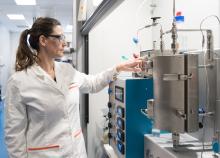
Threading-CO2 project aims to scale-up and demonstrate its first-of-its-kind technology producing high-quality commercially viable sustainable PET textile products from CO2 waste streams.
The overall objective is to significantly reduce the carbon footprint of the textile industry, using a circular manufacturing approach and running on renewable energy sources.
Re-using textiles locally is the most sustainable way to close the textiles loop as well as to deliver local jobs for the circular and just transition.
Social enterprises in the re-use sector seek to implement the waste hierarchy and abide by the proximity principle. As such, they manage to extend textile products’ lifetime locally while equipping vulnerable individuals with circular skills and building local communities.
This paper by RREUSE outlines good practices in responsible used-textile management carried out by our social enterprises community. It focuses on ways to improve textile collection and local reuse and bolster textile transparency.
Textiles are on average the fourth-highest source of pressure on the environment and climate change from a European consumption perspective, as shown in previous EEA briefings.
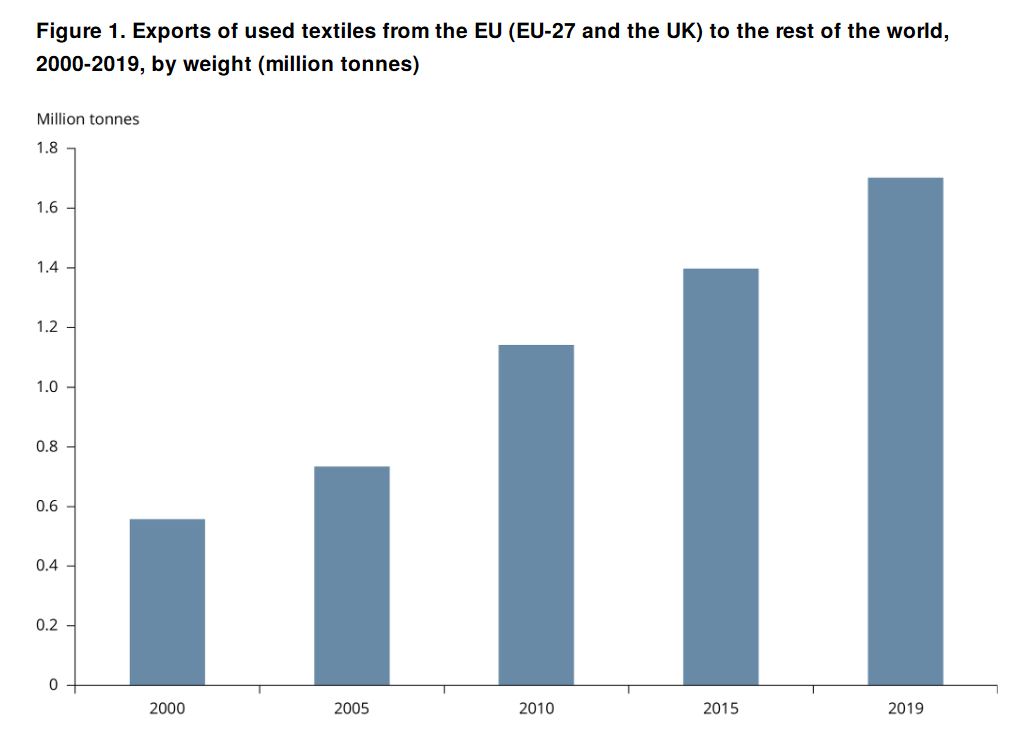
Europe faces major challenges managing used textiles, including textiles waste. As reuse and recycling capacities in Europe are limited, a large share of used textiles collected in the EU is traded and exported to Africa and Asia, and their fate is highly uncertain.
The common public perception of used clothing donations as generous gifts to people in need does not fully match reality.
In the course of two decades, there has been a threefold increase in EU used textiles exports
The University of Cambridge (UK) is running a sector-wide workshop on "Speeding up the Transition to Closed Loop Synthetic Fibre Recycling by 2030". It will help industry experts and policy makers co-create strategic policy solutions on how to speed up the transition away from the use of virgin and non-closed loop sources of synthetics towards a full closed loop textile recycling system across the European Union.
The workshop will be held online from 11:00 to 15:00 (London time) on Tuesday 28 February 2023.
The tExtended European project has come up with an innovative approach to recycling textile waste by developing a knowledge-based masterplan for optimised recycling of discarded textiles. The research combines recycling, waste-valorisation and data technologies to maximise the impact.
Twenty organisations from 10 countries have collaborated to create economically feasible and sustainable solutions for reducing waste in the textiles industry.
The World Circular Economy Forum 2023 will be held in Helsinki from 30 May to 2 June 2023. This global collaboration forum is co-organised by Finnish Innovation Fund Sitra and Nordic Innovation, with international partners. It will attract more than 2 000 leading circular economy players in the world to Finland to find circular solutions that can help our economies fit within the boundaries of nature. Part of the programme will also be accessible online.