Maiano Re-Lab comes up with sustainable industrial applications for textile scraps from mass-produced consumer goods. This initiative establishes synergies between industrial sectors, minimising waste and promoting sustainability within the industry.
The Circular Republic Festival 2025 (#CRF25) will focus on Build Your Competitive Advantage.
It will explore how circular practices can reshape industries and create resilience in the face of resource scarcity and climate challenges. There will be keynote addresses, hands-on workshops and tailored recommendations to help integrate circular principles into business strategies.
The Sustainable Fashion Academy launched the Scandinavian Textile Initiative for Climate Action (STICA) in collaboration with various apparel and textile companies. STICA aims to ensure that the Nordic region and Europe reduce their climate impacts in line with the 1.5°C global warming pathway, while transforming their businesses and the industry.
Signatories to STICA undertake to set targets on scopes 1 to 3 and report back. The focus of this report is emissions reduction, and circular business models are presented as part of the solution. The information provided by the signatory companies as part of their reporting covers circular business models, breaking down how these contribute to scope 3 reduction and their place in the companies' climate action transition plans.
Refashion's Recycle Summit brings together key stakeholders from the textile and footwear sector. It showcases significant achievements in circularity, including groundbreaking technical studies, the development of unique material libraries and measurable environmental impacts. It aims to drive collaboration and innovation, strengthening the adoption of recycled materials and positioning the industry for a sustainable and competitive future.
The ECOFAP project aims to make shoe soles and heels from a material manufactured from tanned leather waste using 3D printing. This research project will help solve the problem of how to recycle leather scraps from the footwear manufacturing industry.
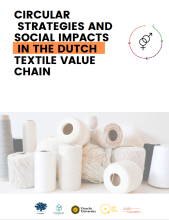
This report is part of a larger, collaborative four-year research project. It analyses the fashion value chain from a global and local perspective with an emphasis on India, Spain and the Netherlands, using a novel framework to assess social impact for circular economy called the SIAF-CE.
The report concludes that the Dutch circular ambition in policy is high and a solid ecosystem is in place. The most established circular strategies are resale and recycling, while promising ones are resale-platform-based, rental and repair. However, the social impact of most circular strategies seems to emulate linear value chain working conditions, where women workers hold the most vulnerable jobs, with low pay, short-term contracts and lower collective bargaining.
Businesses in Spain and around the world are adopting the circular economy as a new production paradigm. However, while the economic and environmental dimensions of the circular economy have been explored, its social impact (decent pay, gender equality, labour conditions) has been overlooked.
By surveying more than 210 workers in three countries and interviewing 90 stakeholders in Spain, the authors developed an inventory of circular jobs. They found that circular jobs in Spain follow the same pattern as the linear value chain, where women in resale, repair and recycling are the most vulnerable. Startups in resale and rental based on internet platform models have the highest earning quality but also high job insecurity, especially for women workers.
The European Commission's Joint Research Centre is organising a second consultation meeting with stakeholders as part of its ongoing work on a preparatory study on textile products. This will support the implementation of the recently adopted Ecodesign for Sustainable Products Regulation.
Businesses in India and around the world are adopting the circular economy as a new production paradigm. However, while the economic and environmental dimensions of the circular economy have been explored, its social impact (decent pay, gender equality, labour conditions) has been overlooked.
By surveying 100 workers and interviewing 40 managers in India, the authors developed an inventory of circular jobs with the respective demographic. They found that circular jobs in India are of low quality due to relatively low wage and job security indicators (especially for female workers). Informal migrant women in resale, repair and recycling are most vulnerable. Resale and rental based on internet platform models have the highest earning quality for men and women.